Breast Stories
Pueraria Mirifica Breast Cream, and Spray: How to Use Them
Cream, gel, serum, spray or massage oil: how Pueraria Mirifica topical formats differ and how to apply them correctly.

Why rapid GLP-1 weight loss can change breast shape, and what non-surgical options can and can't do about it.
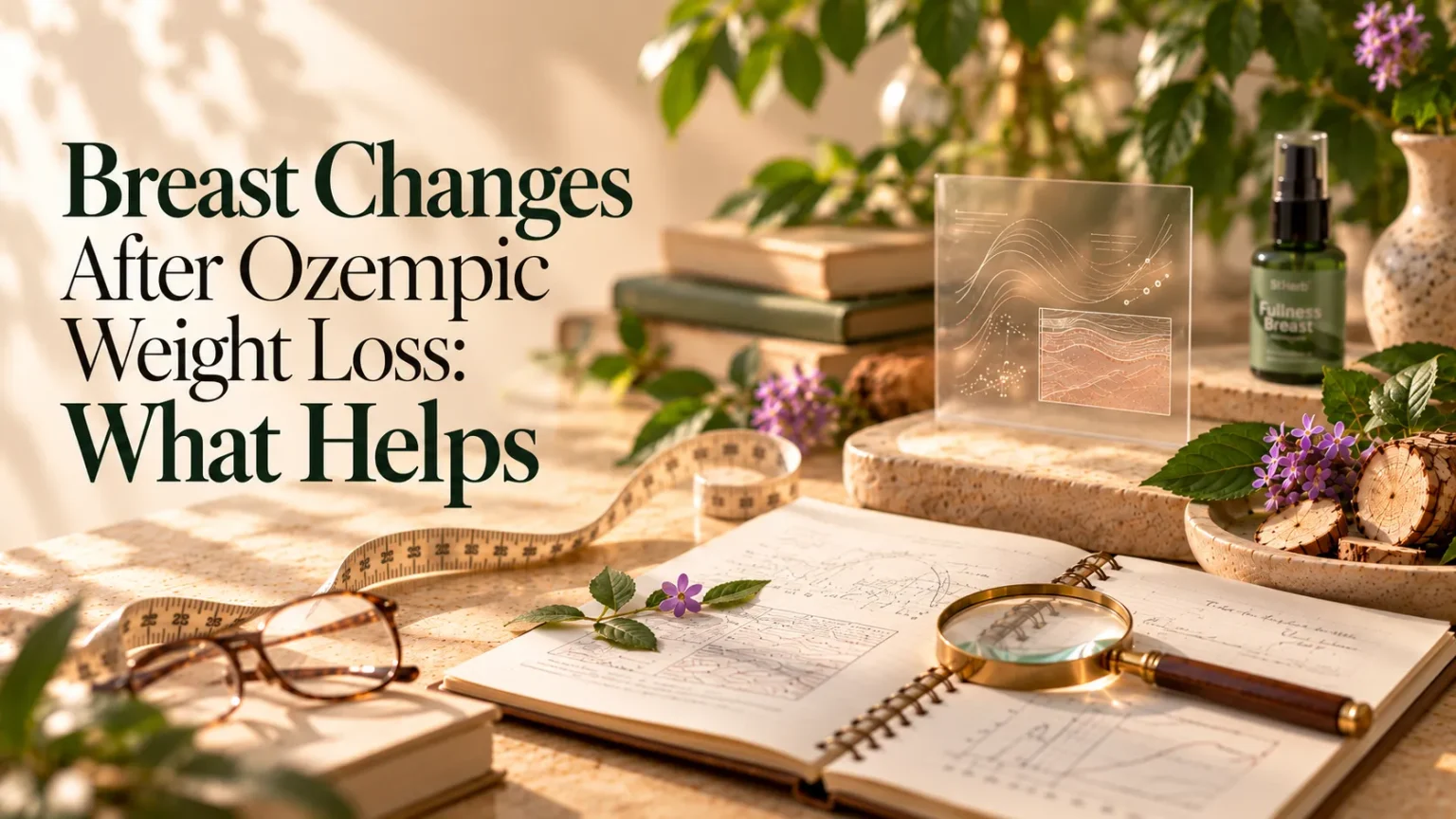
“Ozempic breasts” isn’t a medical diagnosis. It’s a nickname for breast volume loss and sagging that can follow rapid, significant weight loss on GLP-1 medications like Ozempic. It happens because breast tissue is mostly fat, and skin doesn’t always shrink back as quickly as the fat disappears. Non-surgical options can support your skin and posture; they cannot restore breast volume that’s already been lost.
The term describes breast volume loss and sagging noticed after rapid or substantial weight loss while using a GLP-1 medication, according to the American Society of Plastic Surgeons (ASPS). Some people notice less fullness at the top of the breast; others notice looser skin or a lower breast position; many notice a combination of both. ASPS notes that the changes themselves are familiar to surgeons, even if the nickname is new.
The scale of this is real: in its 2025 Procedural Statistics Report, ASPS reported that 82 percent of its member surgeons received consultation requests related to GLP-1 use, and breast lifts grew 8 percent year over year while breast augmentation grew 11 percent.
For a broader look at how weight changes in general, not just GLP-1-related loss, can affect breast size and shape, see how weight gain or loss affects breast size and shape.
Breasts are made up of fat, glandular tissue, connective tissue, and skin. The glandular tissue, which produces milk, doesn’t change size with weight loss; the fat does, according to Mayo Clinic Care Network content, which also lists being overweight and losing a significant amount of weight among the factors that reduce skin elasticity and contribute to sagging, alongside aging and smoking.
ASPS frames this as two separate problems that often show up together after weight loss: volume loss and skin laxity. As the organization’s surgeons explain it, replacing lost volume is only part of the equation when significant weight loss has also left behind loose skin and changed the breast’s position. A surgeon assessing this typically looks at existing breast volume, degree of sagging, skin quality, breast position, and symmetry separately, rather than treating it as one single issue.
Speed matters here. Skin and the ligaments that support the breast stretch to accommodate fat gain, and when a large amount of that fat disappears quickly, the skin has less time to adapt. Gradual weight loss gives skin more time to adjust than rapid weight loss does, which is one reason the pace of weight loss, not just the total amount, affects how noticeable these changes are.
Starting breast composition also plays a role. Someone whose breasts were made up mostly of fat before weight loss is likely to notice a bigger size change than someone whose breasts had more glandular tissue relative to fat, since glandular tissue doesn’t shrink the way fat does. None of this is something you can see or change in advance; it’s simply part of why two people can lose a similar amount of weight and notice quite different breast changes.
For more on posture specifically, see the link between posture and breast appearance. The table below lines up what each of these realistically helps with, and what it doesn’t.
| What you can do | Helps with | Doesn’t help with |
|---|---|---|
| Talk to your prescribing doctor about your pace of weight loss | May reduce how fast your skin has to adapt going forward | Changes to skin or volume that have already happened |
| Adequate protein intake (ask a doctor or dietitian for an amount that fits you) | Supports general skin, muscle, and tissue health during weight loss | Specifically rebuilding breast fat volume that has been lost |
| Pectoral strength training | Can improve chest wall projection and posture, which may change how the chest looks | Breast tissue itself, which contains no muscle, or sagging skin |
| A properly fitted, supportive bra | Shape, comfort, and appearance while it’s worn | The breast tissue once the bra is removed |
| Moisturizing and a gentle massage routine | May support how the skin feels and your own self-care routine | Restoring lost breast volume or fully reversing sagging skin, which no topical or herbal product has been shown to do |
| Good posture | Can change how the chest appears while standing | The underlying tissue or skin laxity itself |
| Breast lift or augmentation surgery | Directly addresses excess skin and/or lost volume, depending on which a surgeon identifies | Anything short of a surgical decision made with a board-certified surgeon |
A simple skin care and massage routine won’t restore lost breast volume, but it can be part of supporting how your skin feels day to day. Keep the area clean, moisturize regularly, and protect the chest skin from sun exposure, since skin that’s dry or sun-damaged generally looks and feels less supple.
A gentle massage routine, using a cream or oil, follows the same basic steps regardless of which product you use: wash and dry the skin first, warm a small amount of product between your palms, apply it to each breast, and massage in gentle circular motions, generally from the outer and lower part of the breast upward, for as long as stated on the product’s label.
To be direct about what this can and can’t do: massage and moisturizing may support how your skin feels and give you a moment of self-care, but no topical or herbal product, including Pueraria Mirifica, has been shown to restore breast volume or fully reverse sagging that follows significant weight loss. For more on supporting skin elasticity specifically, see natural ways to support breast skin elasticity. A related situation, breast changes after pregnancy, is covered separately in our guide to breast sagging after pregnancy, though the cause there is different from weight-loss-related change.
If you’d like to build this into a routine, see the St.Herb Breast Cream or St.Herb Fullness Breast Massage Oil product pages for their own directions, and follow the label or ask your doctor.
If sagging or volume loss bothers you once your weight has settled, a consultation with a board-certified plastic surgeon can clarify what’s actually going on. As ASPS describes it, a surgeon will typically evaluate your breast volume, degree of ptosis, skin quality, position, and symmetry, since volume loss and skin laxity are separate issues that can call for different solutions, a breast lift, augmentation, or sometimes both.
This is a personal decision, not something this article is pushing you toward. The point of seeing a surgeon, if and when you’re ready, is simply to get an assessment specific to your own anatomy rather than guessing from general information. Many surgeons prefer to wait until your weight has been stable for a period of time before operating, since further weight change afterward could affect the result, though the exact timing a surgeon recommends will depend on your individual situation.
It’s a nickname, not a medical diagnosis, for breast volume loss and sagging noticed after rapid or substantial weight loss on GLP-1 medications. It happens because breast tissue is largely fat, which shrinks as you lose weight, while the skin and supporting ligaments don’t always retract at the same pace.
No. These can support your overall skin and muscle health, and may change posture or chest wall appearance slightly, but none of them, including any herbal or topical product, have been shown to restore breast fat volume once it’s gone.
Don’t adjust or stop it on your own. Talk to the doctor who prescribed it about any concerns, including the pace of your weight loss, and let them guide any changes to your treatment.
It may help. Surgeons and clinical sources describe rapid weight loss as harder on skin elasticity than gradual weight loss, since the skin has less time to adjust. It’s not a guarantee, since genetics, age, and starting breast composition also play a role.
If sagging or volume loss bothers you once your weight has settled, a board-certified plastic surgeon can assess your specific breast volume, skin quality, and degree of sagging, since these are often separate problems that need different solutions.
Explore the product this article talks about — crafted from research-backed Thai botanicals.
Cream, gel, serum, spray or massage oil: how Pueraria Mirifica topical formats differ and how to apply them correctly.
Quick answer The gut microbiome plays a role in estrogen and phytoestrogen metabolism and may influence how some plant compounds are absorbed,…
Key Takeaways Thailand’s botanical medicine tradition is one of the most systematically documented in the world — these herbs didn’t appear on…