Breast Stories
Pueraria mirifica and the Gut-Hormone Axis: What Your Microbiome Has to Do with It
Quick answer The gut microbiome plays a role in estrogen and phytoestrogen metabolism and may influence how some plant compounds are absorbed,…

Cream, gel, serum, spray or massage oil: how Pueraria Mirifica topical formats differ and how to apply them correctly.
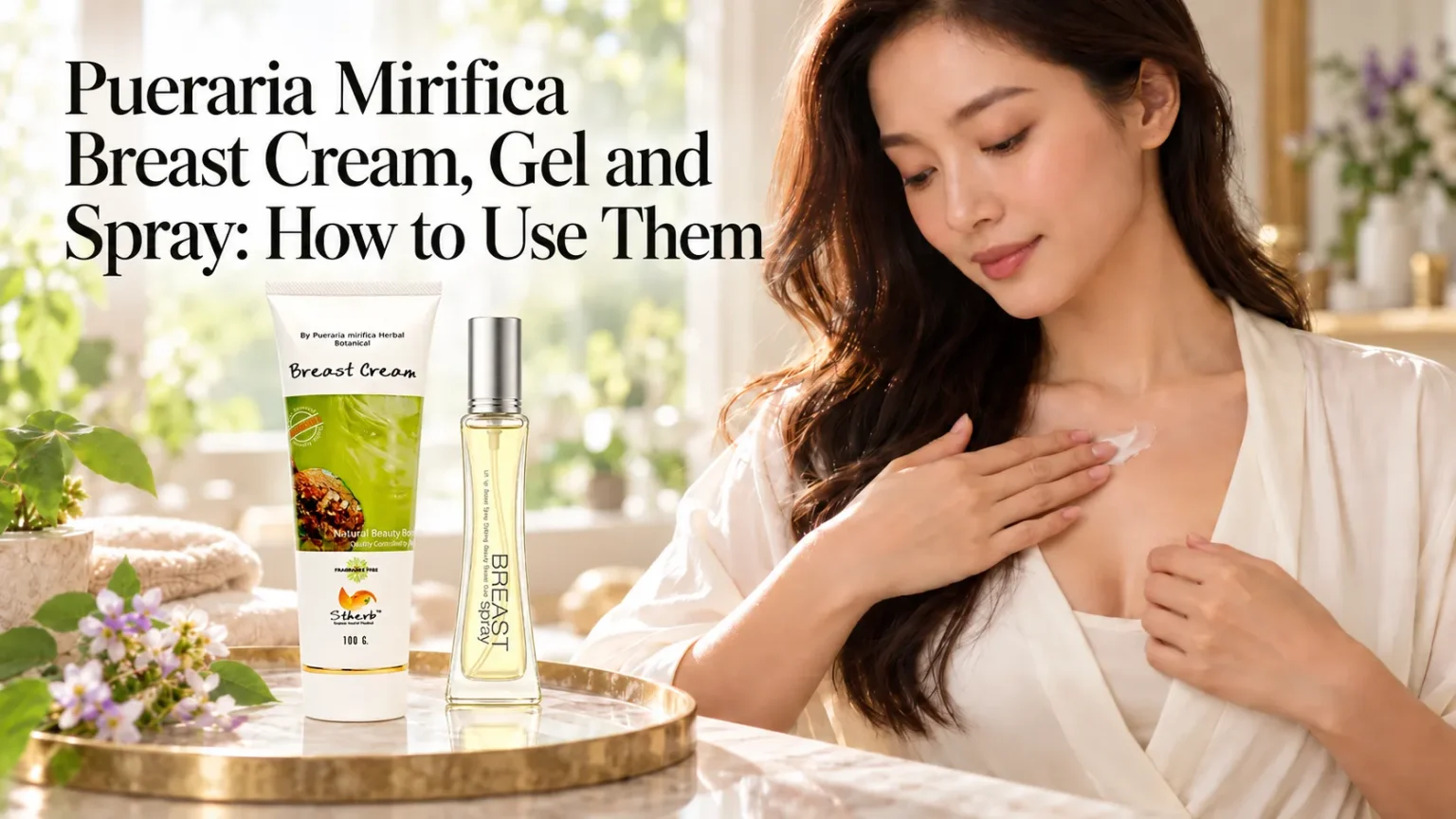
Pueraria Mirifica topical products come in several textures, and the texture, not the ingredient, is what changes how you use them. Cream is thicker and absorbs slowly, serum is light and quick to absorb, a spray is fast and low-effort, and massage oil is made to stay slippery on purpose. This guide covers each format and how to apply it correctly.
All of the formats below can contain the same core ingredient, Pueraria Mirifica extract. What differs is texture, how quickly they absorb, and what situation each one suits best.
Texture is mostly a matter of what the product is formulated with alongside the Pueraria Mirifica extract itself, such as how much oil, water, or thickening agent is used. A richer cream sits on the skin’s surface longer, which can feel more occlusive but also gives your hands more time to massage it in. A lighter serum is designed to sink in quickly, which suits a quick morning routine but gives you a shorter massage window before it’s absorbed. Neither texture changes what the core ingredient is, only how it behaves on your skin and how long you’ll be rubbing it in.
| Texture | Absorption | Suited for | St.Herb product |
|---|---|---|---|
| Cream — thicker, richer texture | Slower; sits on skin longer before fully absorbing | Dry skin, night-time use, all-over coverage | see St.Herb Breast Cream, 100 g |
| Nano cream — a cream processed to a smaller particle size | Marketed for easier skin penetration than a standard cream; see the live product page for specifics | Those who want a lighter cream feel than a standard formula | see St.Herb Nano Breast Cream, 40 g |
| Serum — lighter, more fluid texture | Faster; feels lighter and absorbs more quickly than a cream | Daytime use, layering under other products, those who dislike a heavy feel | see St.Herb Nano Breast Serum, 40 ml |
| Spray — a fine liquid mist (general topical format; St.Herb does not currently offer this format) | Typically fast-drying and convenient, since no massaging in is required | Quick reapplication, travel, or hard-to-reach application | Not currently offered by St.Herb |
This article is about choosing between topical formats specifically. If you’re weighing topical products against capsules or other oral forms instead, see Topical vs Oral Pueraria Mirifica: Which Is Better?. If you’re using both together, see how to combine topical and oral Pueraria Mirifica.
For cream, serum, or massage oil, the general process is the same:
A spray is applied differently: it’s generally misted directly onto the skin and either left to dry or patted in lightly, without the same massage step, since the format is designed for quick, low-effort use.
How firmly you massage matters less than doing it consistently and gently. Pressing hard enough to cause pain or redness isn’t necessary and can irritate the skin, especially if you’re also applying a product with estrogen-like activity to that area. A light, steady pressure, repeated in the same pattern each time, is enough to help the product spread evenly and work it into the skin.
For a fuller breast massage routine beyond basic product application, see our breast massage techniques and breast care tips.
Follow the frequency and amount stated on the specific product’s own label, or ask your doctor. This varies by product and format, so a general number from one product shouldn’t be assumed to apply to another.
For context on how topical Pueraria Mirifica research is typically structured, a skin-resilience test described in a company patent filing applied a Pueraria Mirifica cream to the breast area of 44 healthy women (39 using the active cream, 4 using a placebo) twice daily for two months. A separate study of a Pueraria candollei var. mirifica anti-wrinkle cream tested skin irritation and moisture effects in postmenopausal women using the cream on facial skin, not the breast area. Neither of these is a reason to extend any one product’s test period to every product; the point is only that published testing periods vary, and the product label, not a generic number, should guide how long you use any specific item.
Before using a new topical product anywhere on the breast, apply a small amount to a less visible area, such as the inner forearm, and wait 24 to 48 hours. If you notice redness, itching, swelling, or irritation, do not use the product on your breasts and discontinue use.
Topical application doesn’t bypass the plant’s estrogen-like activity, it just changes how it reaches the body. An animal study in postmenopausal macaques found that a topical vaginal Pueraria Mirifica cream improved tissue health locally without the systemic hormone changes seen with a comparison estrogen cream, in that specific application site and species. That is encouraging for one use case, but it was not tested on breast skin and should not be assumed to apply there.
They are the same core ingredient in different textures. Cream is thicker and absorbs more slowly, serum is lighter and absorbs faster, and a nano version of either is processed to a smaller particle size, marketed for easier penetration than the standard version. Which one suits you is mostly about texture preference and when you plan to use it, such as day versus night.
Not currently. The spray section of this article is general information about the format, included so readers researching sprays understand how they compare, not a description of a St.Herb product.
It depends on the format and the specific product, so always check the product label for guidance. As a general rule, lighter textures like serum absorb faster than richer creams, and massage oil is designed to stay slippery for the length of a massage rather than absorb quickly.
Some people do combine the two, but how to do that well is its own topic. See our guide on combining topical and oral Pueraria Mirifica for more detail, and follow each product’s own label.
Anyone with broken or irritated skin in the application area, a known allergy to any listed ingredient, or who is pregnant or breastfeeding should avoid it or ask a doctor first. The same applies if you have a hormone-sensitive condition. Always patch test first.
Explore the product this article talks about — crafted from research-backed Thai botanicals.
Quick answer The gut microbiome plays a role in estrogen and phytoestrogen metabolism and may influence how some plant compounds are absorbed,…
Key Takeaways Thailand’s botanical medicine tradition is one of the most systematically documented in the world — these herbs didn’t appear on…
Key Takeaways The decline is real but gradual: 1–2% total testosterone per year from around 35, with free testosterone falling faster because…