
The Pueraria Mirifica Plant: Botany, Origin & Native Habitat
What Pueraria Mirifica is botanically, where it grows in Thailand’s hills, and how growers identify and harvest the root that gives it its value.
Key Takeaways
- Pueraria Mirifica is a climbing tuberous legume native to Thailand’s northern and north-eastern forests.
- Its underground tuber — not the leaves or flowers — holds the phytoestrogens used in skincare and supplements.
- Of the three local “Kwao Krua” varieties, only the white-fleshed one is true Pueraria Mirifica.
- Roots are left in the ground for three to five years before harvest to reach useful potency.
A Legume With an Unusual Root
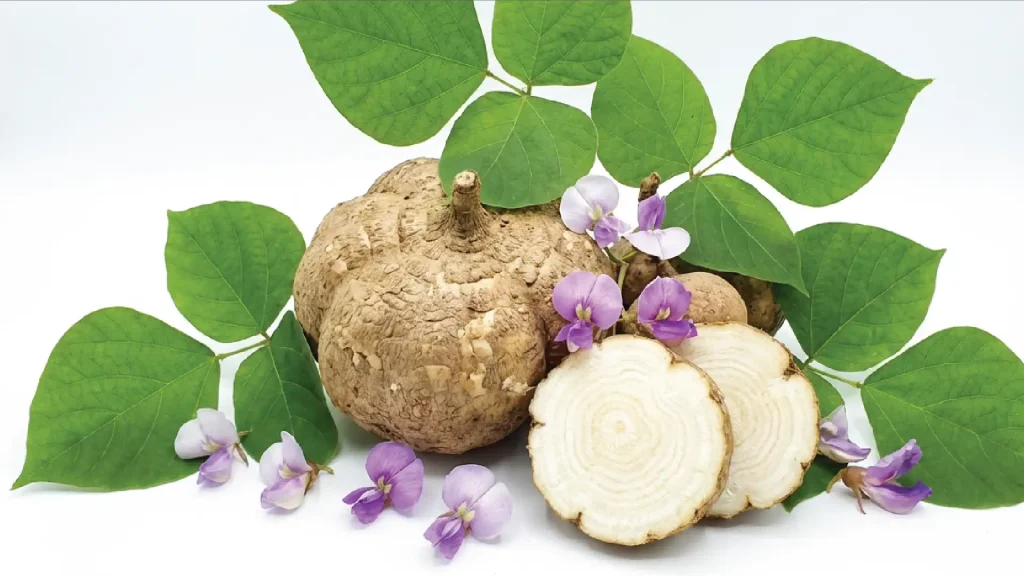
Pueraria Mirifica is a climbing, deciduous vine in the Fabaceae family — the same family as beans and kudzu, to which it’s closely related. Above ground it looks unremarkable: trifoliate leaves, pale purple flowers in the rainy season. What makes the plant valuable grows out of sight — a large, starchy tuber that develops underground and can eventually weigh several kilograms.
That tuber is where the plant concentrates its phytoestrogens — compounds that barely exist anywhere else in nature. Everything St.Herb formulates around Pueraria Mirifica, from cream to serum to capsule, traces back to this one part of the plant.

Native Habitat
Pueraria Mirifica grows wild in the deciduous and mixed forests of northern and north-western Thailand, most notably in Chiang Mai, Chiang Rai, Mae Hong Son and Kanchanaburi provinces. It favors well-drained, slightly acidic hillside soil and a distinct dry season, which is believed to concentrate phytoestrogens in the tuber as the plant stores energy to survive. As demand grew beyond what wild foraging could sustainably supply, St.Herb began cultivating it under similar conditions to protect wild populations.
Telling It Apart From Other “Kwao Krua”
Thai herbal tradition recognizes three “Kwao Krua” tubers, often confused with one another online — only one is Pueraria Mirifica.
-
Kwao Krua Khao (White) — Pueraria Mirifica
The phytoestrogen-rich variety used in breast and skincare products, and the subject of this guide.
-
Kwao Krua Daeng (Red) — Butea Superba
A related tuber traditionally used for men’s vitality, with a different compound profile.
-
Kwao Krua Dam (Black)
Used in general tonics; far less studied and not used in St.Herb formulas.
Frequently Asked Questions
Pueraria Mirifica is a climbing, tuberous legume in the Fabaceae family, related to kudzu. It stores nutrients and phytoestrogens in a large underground tuber that can weigh several kilograms at maturity.
It is native to Thailand's northern and north-eastern provinces, particularly Chiang Mai, Chiang Rai, and Kanchanaburi, growing wild in deciduous forests and increasingly on cultivated farms.
Growers typically wait at least three to five years before harvesting, since phytoestrogen concentration builds up as the tuber matures.
Kwao Krua is the Thai folk name for several related tubers. Pueraria Mirifica is specifically “Kwao Krua Khao” (white Kwao Krua) — the white-fleshed variety prized for its phytoestrogen content, distinct from the red and black varieties.
Next: What’s Actually in the Root
See the full compound breakdown — miroestrol, deoxymiroestrol, isoflavones and more — and what each one does.