Breast Stories
Pueraria Mirifica Breast Cream, and Spray: How to Use Them
Cream, gel, serum, spray or massage oil: how Pueraria Mirifica topical formats differ and how to apply them correctly.


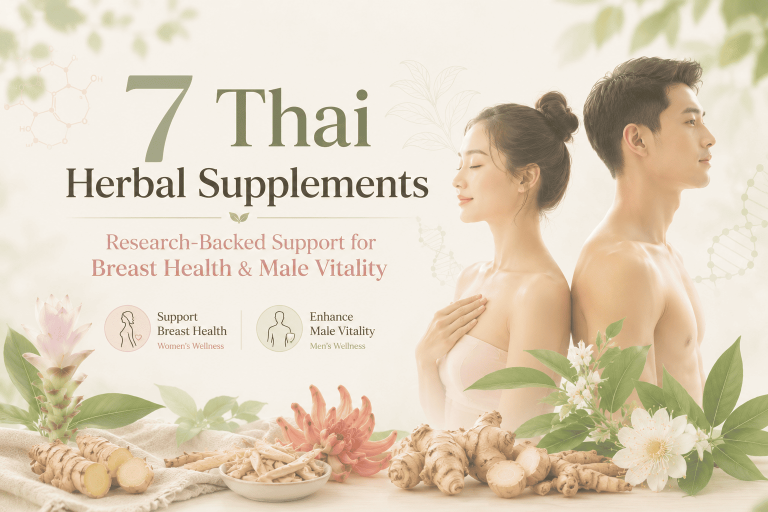
At some point in their forties, many couples find themselves navigating similar experiences from very different directions. She is managing hot flashes and shifts in energy. He is noticing changes in vitality and drive that he cannot fully explain. Conventional medicine offers solutions for each, but increasingly, couples are also looking at plant-based wellness approaches with deep traditional roots. In Thailand, Pueraria mirifica and Butea superba have served as the female and male pillars of herbal vitality medicine for generations. Modern research is beginning to validate why. This article explores how these two herbs work together as a complementary household wellness approach for couples seeking natural hormonal support.
Thai traditional medicine developed a sophisticated understanding of which plants served which physiological roles. Pueraria mirifica, the White Kwao Krua, was associated with feminine rejuvenation, supporting the hormonal changes of aging women, and maintaining breast health and skin vitality. Butea superba, the Red Kwao Krua, held the equivalent role for men, supporting male vitality, energy, and sexual health through the gradual hormonal shifts of aging.
These two plants were not developed in isolation from each other. They represent complementary halves of a broader herbal wellness philosophy that recognized hormonal health as central to quality of life for both women and men as they age. This paired approach is what modern couples are now discovering through research, wellness communities, and growing global interest in Thai botanical medicine.
| For Her — Pueraria mirifica | For Him — Butea superba | |
|---|---|---|
| Traditional name | White Kwao Krua | Red Kwao Krua |
| Supports | Hormonal comfort, skin & breast vitality | Energy, drive, circulation |
| Key compound | Miroestrol | Flavonoids / isoflavonoids |
| Forms | Capsule + topical gel | Capsule + topical gel |
| Typical timeline | 4–8 weeks early, 3–6 months meaningful | 4–8 weeks early, 3–6 months meaningful |
For women in their forties and beyond, the gradual decline in estrogen production can produce a wide range of symptoms. Hot flashes, sleep disruption, vaginal dryness, skin changes, and shifts in breast tissue firmness are among the most commonly reported. These are not simply cosmetic concerns; they reflect meaningful physiological changes that affect daily quality of life.
Pueraria mirifica’s active compound miroestrol, structurally similar to estriol, the gentlest of the human estrogens, interacts with estrogen receptors in ways that may help moderate some of these symptoms. Multiple clinical trials have documented effects on hot flashes, vaginal tissue health, and breast firmness. The 2017 Japanese randomized controlled trial found measurable improvements in breast firmness using an objective structural measurement, while the broader clinical literature reviewed in Annals of Internal Medicine in 2024 found evidence for improvements in genitourinary symptoms of menopause.
For women, Pueraria mirifica offers a phytoestrogenic option that works alongside the body’s existing hormonal system rather than overriding it.
For men navigating their forties and beyond, the hormonal shifts are subtler but no less significant. Testosterone and related hormones decline gradually, and the effects often show up as reduced drive, slower recovery from exercise, decreased energy, and changes in sexual function. Unlike the relatively sharp hormonal transition of menopause, male hormonal aging is a slow gradient.
Butea superba’s mechanism is not simply to raise testosterone. Instead, it appears to support the body’s hormonal regulation systems, particularly through influence on nitric oxide production, which affects blood flow, and through interaction with the pituitary-testicular hormonal axis as documented in research published in the Brazilian Journal of Medical and Biological Research. The 2003 clinical trial in Thai men with erectile dysfunction showed meaningful improvement rates, and small-scale studies have also noted increases in sexual desire.
For men, Butea superba offers support that works with the body’s existing hormonal biology rather than bypassing it, making it appropriate for men who want natural vitality support without the risks associated with synthetic hormone interventions.
What makes the his and hers herbal approach particularly interesting is not just that each herb works for its respective user. It is that building a shared wellness practice around botanical supplementation tends to improve consistency for both partners.
Research on wellness habits consistently shows that shared routines are easier to maintain than individual ones. When both partners are engaged in a daily supplement routine, the accountability, conversation, and shared observation of outcomes create positive reinforcement. Couples who begin herbal wellness routines together often report that the shared practice itself becomes part of their broader health commitment. This is something that St.Herb has observed across its global customer community. Whether couples are based in Europe, Asia, or North America, the pattern of one partner’s results encouraging the other to begin is a common story.
A practical his and hers herbal routine with these two Thai herbs might look like the following: Both partners take their respective capsules in the morning with breakfast, establishing a consistent daily rhythm. She applies Pueraria mirifica topical gel as part of her morning and evening skincare routine, drawing from the women’s care collection. He applies Butea superba topical gel as part of his morning routine, chosen from the men’s range. Both partners maintain a calcium-rich diet that supports the hormonal benefits of each herb, include chest and core exercises that support structural health, and sleep consistently.
The first two weeks are primarily about establishing the habit. Weeks four through eight are typically when early observations emerge. The three to six month mark is where research timelines suggest the most meaningful outcomes develop for both herbs.
Traditional Thai medicine always contextualized these herbs within a broader lifestyle framework, not as isolated fixes. Pueraria mirifica and Butea superba work best when paired with adequate sleep, a diet rich in vegetables and protein, regular physical activity, and stress management practices. The herbs support the body’s natural regulatory systems, but they cannot compensate for a lifestyle that works against those systems.
Both partners should also be aware of the herbs’ contraindications. Pueraria mirifica is not suitable for those with a history of hormone-sensitive conditions without medical supervision. Butea superba should be used within recommended dose ranges. Neither herb should be combined with prescription hormone therapies without discussing the combination with a healthcare provider.
If you’re setting this up as a couple, it helps to read each side on its own terms: the Pueraria mirifica hub for her, and the Butea superba page for him. Each lays out the forms, timelines, and cautions specific to that herb.
Yes. Pueraria mirifica is formulated for female physiology and Butea superba for male physiology, so they serve different hormonal systems. Using them simultaneously as a household herbal wellness routine is entirely appropriate and is a pattern seen in traditional Thai herbal medicine practice.
White Kwao Krua refers to Pueraria mirifica, which contains miroestrol and is traditionally used for female hormonal support. Red Kwao Krua refers to Butea superba, which contains flavonoids and isoflavonoids associated with male vitality and erectile function. They are distinct plants with different active compounds.
Since the herbs serve different hormonal systems, there are no known direct interactions between the two. However, if either partner is taking prescription medications, particularly hormonal therapies, anticoagulants, or medications for cardiovascular conditions, they should consult a healthcare provider before adding either herb.
The research timelines for both herbs suggest that initial observations often appear within four to eight weeks of consistent use, with more significant outcomes developing over three to six months. Shared routines that both partners maintain consistently tend to produce more meaningful results than irregular use.
Yes. Thai traditional medicine developed both Pueraria mirifica and Butea superba as gendered herbal tonics for rejuvenation and vitality. The World Health Organization’s Traditional Medicine Strategy recognizes traditional medicine systems as valuable knowledge frameworks, and Thai botanical medicine is among the most systematically documented in Southeast Asia.
Yes. St.Herb offers Pueraria mirifica in both capsule and topical gel forms for women, and Butea superba in both capsule and topical gel forms for men. A His and Hers bundle is available for couples who want to begin both routines together.
Butea superba is formulated for male physiology and is not intended for women. Pueraria mirifica at high doses may produce feminizing effects in men due to its estrogenic activity, so men should avoid high doses. Some traditional contexts reference low-dose PM for general wellness in older men, but this application lacks strong clinical evidence.
A calcium-rich diet, regular physical activity including chest and core exercises, consistent sleep, and stress management all support the effectiveness of both herbs. Thai traditional medicine always contextualized these botanicals within a broader lifestyle framework rather than as standalone interventions.
The easiest on-ramp for couples is a paired set — explore the St.Herb care packages built to start both routines at once.
Explore Stherb’s Thai herbal skincare and supplements, crafted from research-backed botanicals.
Cream, gel, serum, spray or massage oil: how Pueraria Mirifica topical formats differ and how to apply them correctly.
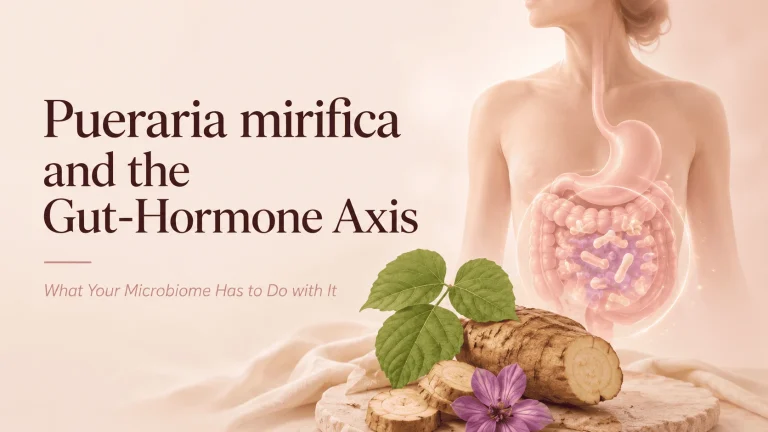
Quick answer The gut microbiome plays a role in estrogen and phytoestrogen metabolism and may influence how some plant compounds are absorbed,…
Key Takeaways Thailand’s botanical medicine tradition is one of the most systematically documented in the world — these herbs didn’t appear on…