Many men in their 40s are still approaching energy and fitness the same way they did 15–20 years ago. More coffee. Push through fatigue. Train harder when results stall. And then wonder why they feel perpetually depleted rather than vitally alive.
Why what worked at 25 no longer works
The physiological reality of being 40-plus is meaningfully different from being 25. Hormonal changes, slower recovery, altered sleep architecture, and cumulative stress all require a fundamentally different approach to building and sustaining energy.
This is not a concession to aging. It is an intelligent adaptation to how your body actually works now — and the men who make this adaptation tend to feel significantly better than those who keep fighting it.
Understanding what energy actually is
Energy is not simply a function of willpower or caffeine. At its foundation, energy is a product of cellular metabolism — specifically how efficiently your mitochondria convert nutrients into ATP, the molecule your body uses for every physical and cognitive function. As men age, mitochondrial efficiency tends to decline, producing more fatigue from the same effort.
Hormonal factors compound this. As testosterone declines, muscle mass tends to decrease — meaning lower basal metabolic activity and lower energy throughout the day. Growth hormone, which peaks during deep sleep, similarly declines with age, reducing overnight recovery.
Sleep: the foundation that everything else depends on
If there is one non-negotiable foundation of male energy after 40, it is sleep quality — not just duration, but the depth and architecture of sleep. Testosterone production, growth hormone release, cortisol regulation, and cellular repair all happen predominantly during restorative sleep.
Men who consistently get less than 7 hours of quality sleep have measurably lower testosterone, higher cortisol, worse insulin sensitivity, and reduced cognitive performance the following day. [1]
What changes in your 40s
Alcohol is significantly more disruptive to sleep architecture in your 40s than it was in your 20s, even in moderate amounts. A cool, dark, and quiet bedroom genuinely contributes to deep sleep quality. Consistent sleep and wake times anchor your circadian rhythm in a way that produces meaningful improvements in energy within two to three weeks.
For men experiencing sleep disruption related to stress or hormonal changes, adaptogenic herbs including ashwagandha and magnesium glycinate have meaningful clinical evidence for improving sleep depth and morning energy levels — supporting the nervous system's ability to recover rather than acting as sedatives.
Exercise: smarter, not just harder
High-intensity exercise remains one of the most potent natural stimuli for testosterone and growth hormone. But without adequate recovery, it becomes a chronic stressor that elevates cortisol and suppresses the very hormones it initially stimulates.
Adequate rest is not wasted time. It is where hormonal recovery and muscular adaptation actually happen.
— Stherb Men's Vitality SeriesThe optimal training structure for men over 40
The most effective approach combines resistance training two to three times per week — which directly stimulates testosterone and maintains muscle mass — with lower-intensity aerobic work on other days, and at least one full rest day weekly.
Compound movements including squats, deadlifts, rows, and presses produce the strongest hormonal stimulus available through exercise. Progressive overload, consistently increasing the challenge over time, maintains the anabolic signal that keeps muscle tissue and hormone levels robust.
Men who maintain or build muscle mass in their 40s consistently report higher energy, better mood, and greater physical and mental resilience. Muscle is the metabolic engine — protect it.
Nutrition for sustained energy and hormonal support
Diet affects male energy through multiple mechanisms simultaneously: blood sugar regulation, micronutrient adequacy, inflammation levels, and the availability of raw materials for hormone synthesis.
The role of herbal support in a men's vitality routine
Traditional botanical medicine has a long history of supporting male energy and stamina, and several herbs are now the subject of genuine scientific investigation.
Butea superba
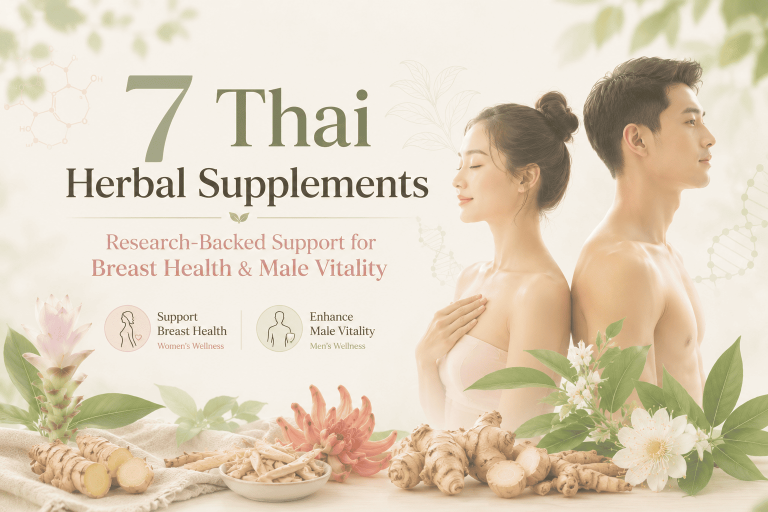
Used in Thai traditional medicine as a male vitality tonic, Butea superba contains flavonoid compounds studied for their potential role in supporting male energy and circulatory health. Its traditional use as a stamina herb reflects an empirical understanding that predates — but is increasingly supported by — modern pharmacological inquiry. [8] These herbs work best as part of a comprehensive approach supporting sleep, stress management, and physical training.
Building consistency: the real foundation of lasting energy
The men who build and maintain genuine energy and stamina in their 40s and beyond are not doing anything dramatically different. What distinguishes them is consistency. They sleep well most nights, not occasionally. They train regularly with adequate recovery programmed in. They eat well habitually, not perfectly. They manage stress as an ongoing practice.
Male energy and stamina after 40 are not about pushing harder than you did at 25. They are about recovering smarter, fuelling more precisely, and giving your body the specific support it needs for this phase of life.
Vitality at 40-plus is a compounding asset. Every week of consistent sleep, movement, and nutritional quality adds to a foundation that makes the next week easier and more productive. The best time to start building yours is now.
Stherb Men's Health Range
Butea superba formulations developed to complement an active, health-conscious lifestyle — grounded in both traditional use and contemporary research.
Learn more at stherbNot a substitute for medical advice. Always consult a healthcare professional for personalised guidance.
Why does energy decline so much in your 40s compared to your 30s?
Is it possible to build muscle and maintain testosterone naturally after 40?
How does alcohol affect male energy and testosterone?
What supplements actually work for male energy?
How important is stress management for male energy levels?
Is it normal to need more recovery time between workouts in your 40s?
What is the best exercise type for boosting testosterone naturally?
- Leproult, R., & Van Cauter, E. (2011). Effect of 1 week of sleep restriction on testosterone levels in young healthy men. JAMA, 305(21), 2173–2174. https://doi.org/10.1001/jama.2011.710
- Wankhede, S., et al. (2015). Examining the effect of Withania somnifera supplementation on muscle strength and recovery. JISSN, 12(1), 43. https://doi.org/10.1186/s12970-015-0104-9
- Prasad, A. S., et al. (1996). Zinc status and serum testosterone levels of healthy adults. Nutrition, 12(5), 344–348. https://doi.org/10.1016/S0899-9007(96)80058-X
- Kraemer, W. J., & Ratamess, N. A. (2005). Hormonal responses and adaptations to resistance exercise and training. Sports Medicine, 35(4), 339–361. https://doi.org/10.2165/00007256-200535040-00004
- Pitteloud, N., et al. (2005). Relationship between testosterone levels, insulin sensitivity, and mitochondrial function in men. Diabetes Care, 28(7), 1636–1642. https://doi.org/10.2337/diacare.28.7.1636
- Mohamad, N. V., et al. (2016). A concise review of testosterone and bone health. CIA, 11, 1317–1324. https://doi.org/10.2147/CIA.S115472
- Cinar, V., et al. (2011). Effects of magnesium supplementation on testosterone levels of athletes and sedentary subjects. BTER, 140(1), 18–23. https://doi.org/10.1007/s12011-010-8676-3
- Charoenphandhu, N., et al. (2007). Effect of Butea superba Roxb. on androgen-sensitive gene expression. AJA, 9(2), 232–238. https://doi.org/10.1111/j.1745-7262.2007.00237.x
- Hackney, A. C., & Aggon, E. (2018). Chronic low testosterone levels in endurance trained men. JBP, 1(1), 1–4. https://doi.org/10.16966/2572-7559.103