Breast Stories
Pueraria Mirifica Breast Cream, and Spray: How to Use Them
Cream, gel, serum, spray or massage oil: how Pueraria Mirifica topical formats differ and how to apply them correctly.

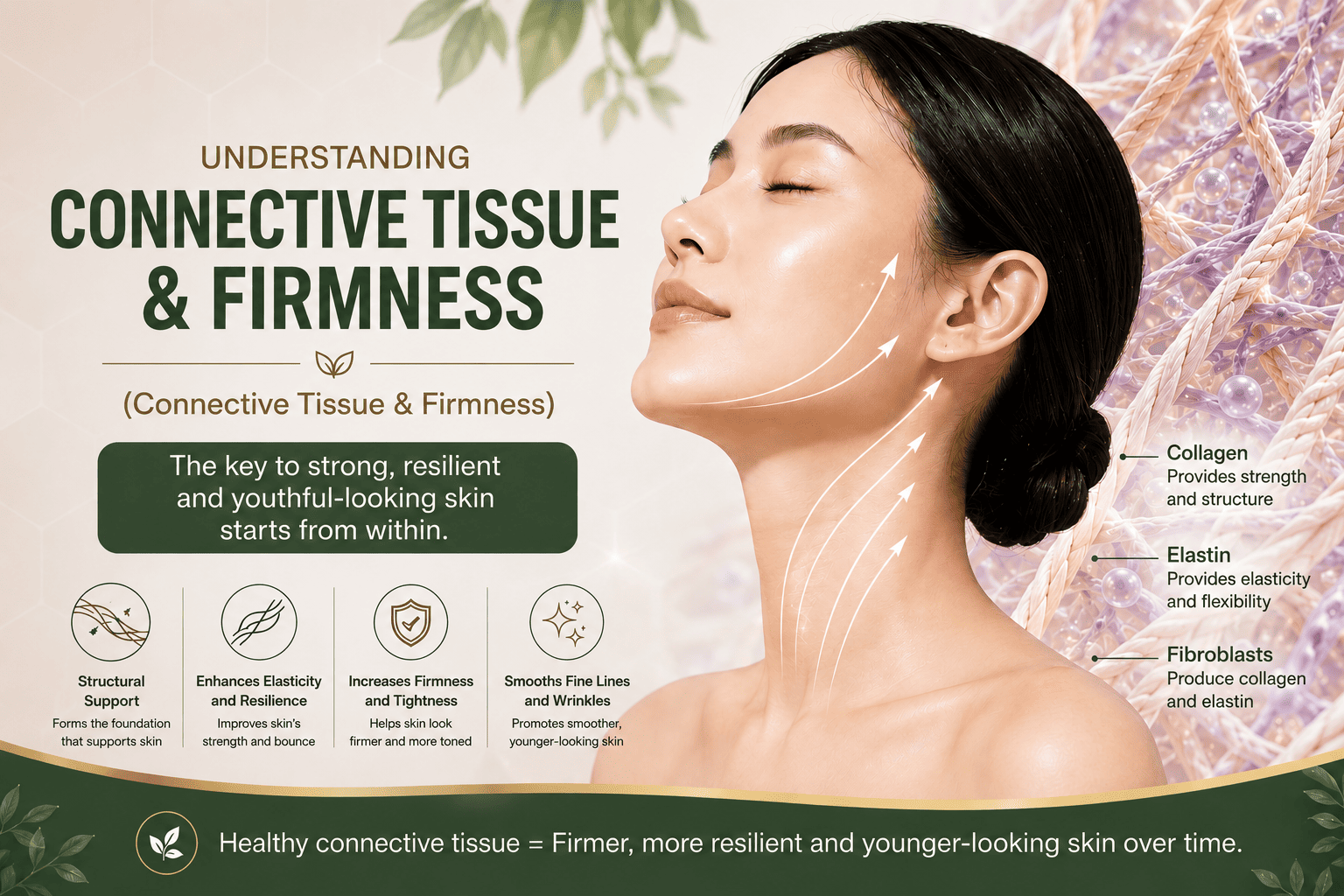
The part of skin most people interact with — the part they touch, treat, and photograph — is mostly dead. The living, active layer is the dermis underneath: a dense matrix of collagen fibers, elastin, and fluid. This is where firmness either exists or doesn't.
When the dermis is healthy, collagen fibers are tightly organized, elastin is springy, and hyaluronic acid keeps everything hydrated from within. The visible result is skin that looks lifted, even, and resilient. When this network starts to thin — through age, sun exposure, stress, poor nutrition, or hormonal change — the surface follows. That's where sagging, crepiness, and loss of definition come from.
The good news is that this system is dynamic, not fixed. It responds to inputs. How you eat, sleep, move, and care for your skin from the outside actually matters — not just as marketing language, but as real biology.
Understanding firmness comes down to three structural proteins and one molecule:
All three are produced by fibroblast cells in the dermis. Feed those cells well — with good nutrition, antioxidant protection, and consistent topical care — and they keep working. Neglect them, and they slow down faster than they need to.
| Component | Primary Function | What Damages It |
|---|---|---|
| Collagen (Type I/III) | Structural density and volume | UV exposure, smoking, high sugar intake, chronic stress |
| Elastin | Flexibility and snap-back quality | Aging, UV radiation, oxidative stress |
| Hyaluronic Acid | Moisture binding and plumpness | Dehydration, aging, environmental pollution |
| Fibroblasts | Produce collagen, elastin, and HA | Nutritional deficiencies, inflammation, poor sleep |
Collagen production peaks in your early twenties and starts its slow decline around 25. The drop isn't dramatic at first — it's around 1% per year — but it compounds. By 40, the difference is visible. By menopause, when estrogen falls sharply (and estrogen directly supports collagen synthesis), some women notice a more sudden shift in skin texture and firmness.
But age isn't the only factor — and it's not even the biggest one. UV radiation is. Unprotected sun exposure activates enzymes called matrix metalloproteinases that physically break down collagen fibers. A decade of inconsistent sun protection in your 20s and 30s often shows up more clearly on skin at 45 than a decade of poor diet does. Smoking, chronic stress, high sugar intake, and alcohol all accelerate the same breakdown pathways.
The practical takeaway: genetics matter, but lifestyle matters more. Skin in its 50s that's been consistently protected, nourished, and cared for looks structurally different from skin that hasn't — regardless of the genes underneath.
Most firmness routines fail not because the approach is wrong, but because people try to do too many things at once and none of it sticks. The basics, done consistently, outperform the complicated. Here's what the evidence consistently points to:
| Lifestyle Pillar | Why It Matters | Practical Starting Point |
|---|---|---|
| Protein intake | Amino acids (especially glycine and proline) are the building blocks of collagen | Aim for 1.2–1.6g of protein per kg of body weight daily |
| Vitamin C | Essential cofactor for collagen synthesis; also an antioxidant | Citrus, bell peppers, strawberries, kiwi daily |
| Hydration | Keeps extracellular matrix plump and supports nutrient delivery | 2–2.5 liters of water per day as a baseline |
| Sun protection | UV is the largest external driver of collagen breakdown | SPF 30–50 on exposed areas daily, year-round |
| Resistance exercise | Mechanical load stimulates fibroblast activity and collagen synthesis | 2–3 sessions of strength training per week |
| Quality sleep | Growth hormone (which stimulates collagen) peaks during deep sleep | 7–9 hours, consistent sleep and wake times |
Let's be direct: no topical product can rebuild collagen from the outside in. Collagen is a structural protein made deep inside the dermis — a cream sitting on the skin surface can't reach it, no matter what the marketing says. If you've been sold on the idea of "collagen-infusing" skincare, that's worth letting go of.
But dismissing topical care entirely would also be wrong. What a well-formulated body cream actually does is more subtle — and more real:
That last point matters more than any ingredient. Skin that gets consistent attention — even modest attention — behaves differently than skin that doesn't. The ritual is the intervention.
Most body care routines skip the chest entirely — which is a shame, because the décolletage has thinner skin than the face and gets just as much sun exposure. St.Herb's Breast Care range is built specifically for this area. The Essential Care formula is designed to be massaged in — not just applied. The Nano Boost Breast Cream uses nano-encapsulated herbal ingredients designed to interact more effectively with the skin surface. Neither replaces what nutrition and sleep do deeper down — but they're the part of the routine you can feel working every single evening.
Complicated routines don't last. Here's what works in practice — stripped down to what actually moves the needle:
After about eight to twelve weeks of this, skin texture tends to shift noticeably. Not dramatically — but meaningfully. Softer to the touch, smoother at the surface, more consistently hydrated. That's what accumulated care looks like in practice.
The skincare industry runs on the promise of transformation. The reality is more boring and more empowering: skin responds to consistent input, not dramatic interventions. The women with genuinely healthy skin at 45 and 55 are rarely the ones who found a miracle cream — they're the ones who kept a boring routine going for years.
Dedicated breast and décolletage care sits in that same category. Not glamorous. Not instant. But the chest area genuinely benefits from products formulated for its specific needs — thinner skin, higher sensitivity, less sebaceous activity than the face — rather than whatever body lotion happens to be in the shower.
It's the structural quality of the dermis — the deep skin layer made of collagen, elastin, and hyaluronic acid. When this network is healthy, skin looks firm and bounces back when you touch it. As it degrades — through age, UV exposure, poor nutrition, or hormonal shifts — skin starts to lose that resilience. You can see it as sagging, crepiness, or a loss of the "solidity" that skin had in your twenties.
Collagen production starts declining around 25, but the changes are gradual enough that most women don't notice until their mid-to-late 30s. The shift tends to accelerate around perimenopause — not just because of age, but because estrogen (which directly supports collagen synthesis) drops. That said, lifestyle choices in your 20s and 30s have a bigger impact on how skin looks at 45 than most people expect.
Genetics set a baseline, but they're not the ceiling. Consistent sun protection, a protein-rich diet with adequate vitamin C, resistance exercise, quality sleep, and dedicated topical care all have real, documented effects on collagen support and skin texture. The women with noticeably healthy skin in their 50s almost always have a history of consistent habits — not exceptional DNA.
Topical cream won't rebuild collagen from the outside — that's physiologically impossible. What it does do is real: it maintains skin hydration (which changes how skin looks and feels immediately), creates the daily massage habit (which improves circulation and lymphatic drainage in that area), and delivers antioxidants that offer some protection against oxidative damage. Used consistently, that's not nothing. It's just not the transformation that some marketing suggests.
Surface hydration and texture — within two to four weeks of consistent daily use. Anything related to collagen support, skin density, or structural changes takes longer: typically eight to twelve weeks minimum of consistent habits (topical care plus nutrition plus sleep). Skin remodeling is slow by design. The upside is that the improvements, when they come, tend to stick.
Explore St.Herb's complete Women's Breast Care range — formulated with herbal ingredients to support hydration, softness, and skin texture as part of your daily routine.
Explore Stherb’s Thai herbal skincare and supplements, crafted from research-backed botanicals.
Cream, gel, serum, spray or massage oil: how Pueraria Mirifica topical formats differ and how to apply them correctly.
Quick answer The gut microbiome plays a role in estrogen and phytoestrogen metabolism and may influence how some plant compounds are absorbed,…
Key Takeaways Thailand’s botanical medicine tradition is one of the most systematically documented in the world — these herbs didn’t appear on…