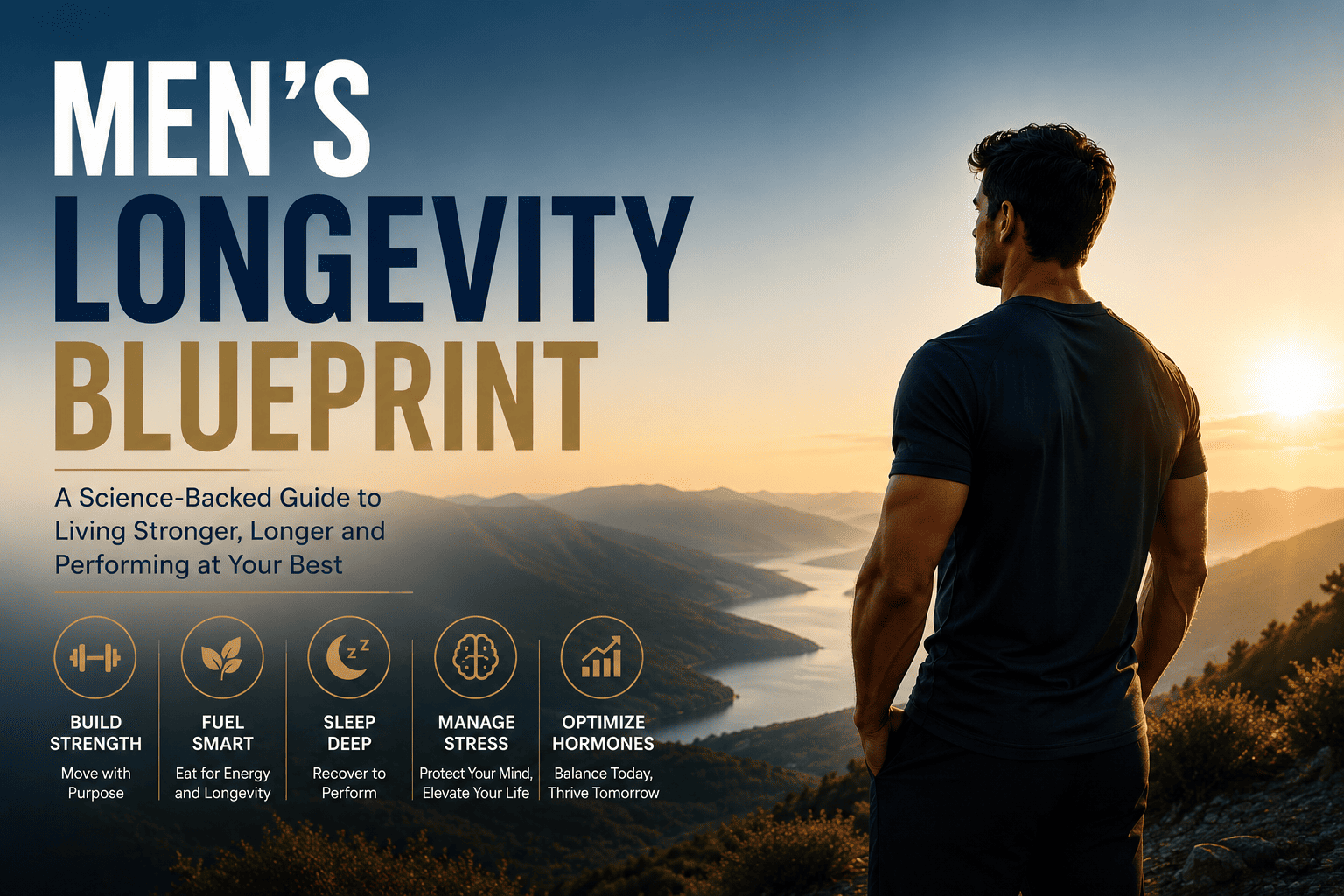
The Men's Longevity Blueprint: What Living Well into Your 50s, 60s, and Beyond Actually Requires
Longevity for men is not about living longer in decline. It is about extending the years of genuine vitality, function, and engagement — and the science is more hopeful than most men realise.
Redefining What Aging Well Means for Men
The conventional narrative around men and aging tends to fall into one of two camps. Either aging is presented as an inevitable decline to be accepted stoically, or it is framed as something to be fought aggressively with extreme interventions. Neither framing is particularly useful — or accurate.
The emerging science of male longevity tells a more nuanced and considerably more hopeful story. The men who maintain the highest quality of life into their 60s, 70s, and beyond are not doing so through heroic willpower or expensive medical interventions. They are doing so through a small set of consistent, evidence-based habits maintained over decades.
"The compound interest of consistent healthy habits, applied over decades, is what genuine male longevity actually looks like in practice."
The Longevity Pillars That Research Consistently Supports
Large-scale longitudinal studies — including the Harvard Study of Adult Development, which has followed men for over 80 years — consistently identify the same core factors in healthy male aging. They are perhaps less exciting than the latest biohacking trend, but they are also far more reliably effective.
-
Sleep quality Consistently ranked as the single most important lifestyle variable for longevity and cognitive preservation. Men who prioritise sleep throughout midlife have significantly lower rates of cardiovascular disease, metabolic dysfunction, and cognitive decline in later decades.
-
Muscle mass maintenance Skeletal muscle is one of the strongest predictors of longevity in men. Higher muscle mass in your 40s and 50s is associated with significantly lower all-cause mortality risk — driven by muscle's role in metabolic health, glucose regulation, and functional independence.
-
Social connection The quality of relationships is among the most robust predictors of male health span. Social isolation in men carries health risks comparable to smoking 15 cigarettes per day (Holt-Lunstad et al., 2015). Meaningful connection is a biological necessity, not a wellness add-on.
-
Stress management Chronic psychological stress accelerates biological aging measurably — including through telomere shortening. Men who develop effective stress management practices in midlife show slower physiological aging markers than those who do not.
-
Purposeful engagement Men with clear purpose — through work, community, creativity, or mentorship — consistently show better cognitive and physical health outcomes in later years.
Hormonal Health as a Longevity Foundation
Testosterone is not just a vitality hormone — it is a longevity hormone. Men with chronically low testosterone have higher rates of cardiovascular disease, metabolic syndrome, osteoporosis, and depression than their age-matched peers with healthier hormonal profiles.
Maintaining hormonal health across midlife is therefore not vanity or performance optimisation. It is a legitimate longevity strategy. The most effective approaches are lifestyle-based: regular resistance training, sleep optimisation, stress management, nutritional adequacy, and consistent physical activity. These factors have meaningful, measurable effects on hormonal profile and are available to virtually every man regardless of circumstance.
The Cardiovascular Connection
Cardiovascular health is the most critical modifiable longevity factor for men. Heart disease remains the leading cause of premature death in men globally, and the foundation of cardiovascular risk is typically laid in the 30s and 40s — a decade or more before symptoms appear. This is the window when prevention is most powerful.
Aerobic exercise is the most potent cardiovascular longevity intervention available. Even 150 minutes per week of moderate-intensity aerobic activity — approximately 20 minutes per day — reduces all-cause cardiovascular mortality significantly. Combined with resistance training for metabolic health and body composition, the two-pronged exercise approach is the most evidence-backed longevity strategy a man can adopt.
Did You Know
Healthy circulation supports energy delivery to tissues, cognitive function, and physical endurance. Traditional herbs including Butea superba have been explored for their potential role in supporting healthy circulation in men — reflecting the longstanding recognition that vascular health and male vitality are deeply interconnected.
Cognitive Longevity: Keeping Your Mind Sharp
Cognitive decline is among the most feared aspects of aging for men — and yet it is also among the most preventable. The lifestyle factors that protect cardiovascular health largely overlap with those that protect cognitive health: regular exercise, good sleep, social engagement, stress management, and nutritional quality.
Aerobic exercise increases brain-derived neurotrophic factor (BDNF), which supports the growth and maintenance of brain cells and has been shown to meaningfully reduce the rate of age-related cognitive decline. Sleep is when the brain clears metabolic waste products associated with cognitive aging — making sleep quality a genuine cognitive longevity intervention, not simply a comfort factor.
Chronic stress is one of the most damaging factors for cognitive aging, operating through both inflammatory and hormonal mechanisms. Elevated cortisol over sustained periods affects areas of the brain central to memory and learning — one of the most compelling reasons to treat stress management as a long-term cognitive investment.
Herbal Traditions and Male Longevity
Traditional medicine systems across Southeast Asia have long recognised specific herbs as supports for male longevity and sustained vitality. Butea superba, used in Thai traditional medicine for its tonic properties in older men, represents a class of botanical supports that modern research is beginning to examine through the lens of circulation, hormonal activity, and adaptogenic function.
The traditional use of such herbs was not primarily about performance enhancement in the modern sense. It was about maintaining the quality and energy of life across the full arc of a man's years — preserving vitality, engagement, and function well into old age. This framing aligns closely with what contemporary longevity research identifies as the determinants of genuine health span.
Putting It Together: The Blueprint in Practice
The men's longevity blueprint is not complicated, though it does require consistency. Sleep well most nights. Train with both resistance and aerobic work, regularly and with adequate recovery. Eat whole, nutrient-dense food that supports hormonal and metabolic health. Manage stress as an ongoing practice. Maintain genuine relationships. Engage with work, creativity, or community that gives your days meaning.
The men who feel genuinely vital in their 60s did not discover a secret. They simply took the fundamentals seriously for long enough that the compound interest paid off.
Longevity is not a destination. It is the result of thousands of small, consistent choices made across decades — about sleep, movement, nourishment, connection, and purpose. The blueprint is available to every man who chooses to take it seriously.
Support Your Long-Term Vitality
Stherb's Men's Health Range — including Butea superba formulations grounded in Thai botanical tradition and contemporary quality standards — is designed for men who view their health as a long-term investment.
Not a substitute for medical advice. Always consult a healthcare professional for personalised guidance.
Learn more at stherb.com →Frequently Asked Questions
What are the most important lifestyle factors for male longevity?
Research consistently identifies sleep quality, muscle mass maintenance through resistance training, aerobic fitness, meaningful social relationships, effective stress management, and purposeful engagement as the core determinants of healthy male longevity. Men who address several simultaneously see significantly better long-term outcomes than those who focus on only one or two.
How does testosterone relate to longevity in men?
Men with chronically low testosterone have higher rates of cardiovascular disease, metabolic syndrome, osteoporosis, and depression compared to age-matched peers with healthier hormonal profiles. Maintaining testosterone through lifestyle means — resistance training, quality sleep, stress management, and nutritional adequacy — is a genuine longevity strategy with broad health benefits.
Can resistance training really reduce mortality risk in men?
Yes. Multiple large-scale studies have found that men with higher muscle mass in midlife have significantly lower all-cause mortality risk. Resistance training also improves insulin sensitivity, reduces cardiovascular risk factors, supports hormonal health, and preserves cognitive function — making it arguably the single most valuable exercise modality for male longevity.
What role does social connection play in men's health?
Research shows that social isolation carries health risks comparable to smoking 15 cigarettes per day. Men with rich social connections have lower rates of cardiovascular disease, cognitive decline, depression, and premature mortality. For men, actively maintaining relationships is a meaningful, evidence-backed longevity intervention.
How does chronic stress accelerate aging in men?
Chronic stress elevates cortisol, which suppresses testosterone and growth hormone, impairs sleep, increases abdominal fat and inflammation, damages brain areas involved in memory, and measurably shortens telomeres — a marker of biological aging. Men who develop consistent stress management practices show slower physiological aging markers and better hormonal profiles.
What can men do to protect cognitive function as they age?
Regular aerobic exercise is the most evidence-backed cognitive longevity intervention available. Quality sleep allows the brain to clear metabolic waste products. Social engagement, stress management, and a diet low in processed foods all contribute meaningfully. Starting these habits in the 40s produces the greatest long-term cognitive benefit.
Is Butea superba relevant for older men specifically?
Butea superba has been used in traditional Thai medicine as a tonic for older men, with a historical focus on maintaining vitality, energy, and circulatory health across the later years of life. Contemporary research is examining its flavonoid compounds for potential roles in supporting male hormonal activity and circulation. It is intended as a complementary support within a comprehensive wellness approach, not a standalone intervention.
How early should men start thinking about longevity habits?
The 30s and 40s are the most impactful window for establishing longevity habits, as this is when many key risk factors for later-life disease begin to develop. Starting or significantly improving health habits in this window produces disproportionate long-term benefit.
References (APA 7th Edition)
- Vaillant, G. E. (2012). Triumphs of experience: The men of the Harvard Grant Study. Harvard University Press.
- Holt-Lunstad, J., Smith, T. B., Baker, M., Harris, T., & Stephenson, D. (2015). Loneliness and social isolation as risk factors for mortality: A meta-analytic review. Perspectives on Psychological Science, 10(2), 227–237. https://doi.org/10.1177/1745691614568352
- Kraemer, W. J., & Ratamess, N. A. (2005). Hormonal responses and adaptations to resistance exercise and training. Sports Medicine, 35(4), 339–361. https://doi.org/10.2165/00007256-200535040-00004
- Erickson, K. I., et al. (2011). Exercise training increases size of hippocampus and improves memory. Proceedings of the National Academy of Sciences, 108(7), 3017–3022. https://doi.org/10.1073/pnas.1015950108
- Epel, E. S., et al. (2004). Accelerated telomere shortening in response to life stress. Proceedings of the National Academy of Sciences, 101(49), 17312–17315. https://doi.org/10.1073/pnas.0407162101
- Mohamad, N. V., Soelaiman, I. N., & Chin, K. Y. (2016). A concise review of testosterone and bone health. Clinical Interventions in Aging, 11, 1317–1324. https://doi.org/10.2147/CIA.S115472
- Charoenphandhu, N., et al. (2007). Effect of Butea superba Roxb. on androgen-sensitive gene expression in male mouse reproductive organs. Asian Journal of Andrology, 9(2), 232–238. https://doi.org/10.1111/j.1745-7262.2007.00237.x
- Leproult, R., & Van Cauter, E. (2011). Effect of 1 week of sleep restriction on testosterone levels in young healthy men. JAMA, 305(21), 2173–2174. https://doi.org/10.1001/jama.2011.710
- Piercy, K. L., et al. (2018). The physical activity guidelines for Americans. JAMA, 320(19), 2020–2028. https://doi.org/10.1001/jama.2018.14854
- Schoenfeld, B. J., Ogborn, D., & Krieger, J. W. (2017). Dose-response relationship between weekly resistance training volume and increases in muscle mass. Journal of Sports Sciences, 35(11), 1073–1082. https://doi.org/10.1080/02640414.2016.1210197