Men Series
Butea Superba Side Effects and Safety: What to Know
Reported Side Effects Butea superba, also called red Kwao Krua, has a long history in Thai traditional medicine. But a long history…

Tongkat Ali and Butea superba compared: origin, key compounds, what human studies show, side effects, and whether you can take both.
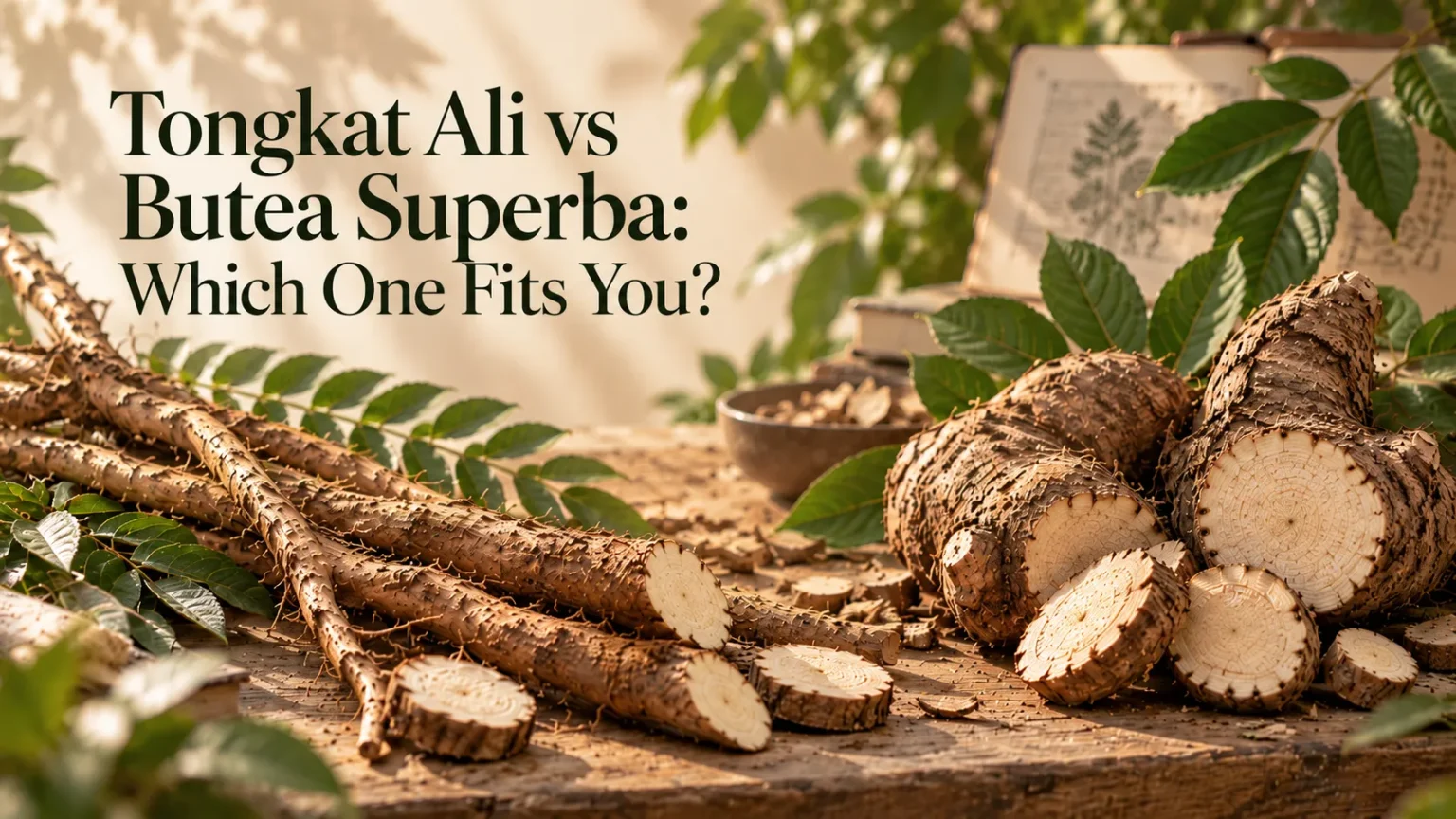
Tongkat Ali has the stronger human evidence. A 2022 meta-analysis of five randomized trials (232 men) found higher total testosterone, though the trials were small. Butea superba has far less, and its one randomized trial found no testosterone change. Neither has been proven to help any medical condition, so ask a doctor before choosing or combining them.
Here is the short version side by side. The sections after it explain each row and show where the evidence comes from.
| Herb | Origin | Key compounds | Human evidence | Common forms | May suit |
|---|---|---|---|---|---|
| Tongkat Ali (Eurycoma longifolia) | Root of a Southeast Asian tree, used in Malaysia, Indonesia, Thailand and Vietnam | Quassinoids such as eurycomanone, plus alkaloids | Several small randomized trials. A 2022 meta-analysis of 5 trials (232 men) found higher total testosterone. | Root powder, water extracts, liquid extracts, capsules | Readers who want the herb with the larger human research base on testosterone |
| Butea superba (red Kwao Krua) | Tuber of a climbing vine from Thailand and nearby parts of Asia | Flavonoids, flavonoid glycosides, isoflavones and sterols | Two small studies. The one randomized trial (39 men enrolled) found no change in testosterone. | Capsules, powder, gels | Readers drawn to the traditional Thai tuber herb who accept thinner evidence |
Tongkat Ali is the root of Eurycoma longifolia, a tropical tree known as Malaysian ginseng in Malaysia and Pasak Bumi in Indonesia. “Tongkat” means walking stick, a nod to the long, twisted roots, according to a 2013 toxicity study. A 2023 review in Frontiers in Pharmacology calls it a well-known botanical used as an aphrodisiac.
Butea superba is a climbing vine in the legume family. Its tuber is the red Kwao Krua of Thai traditional medicine, described in a 2010 rat study abstract as a traditional Thai male potency herb.
Both belong to the tradition of tonic herbs. If you are curious how tonic herbs differ from adaptogens, see Tonic Herbs vs Adaptogens, and for a wider tour of Thai herbs, see 7 Thai Herbal Supplements: Research-Backed Breast Health and Male Vitality.
More than 65 compounds have been isolated from Tongkat Ali, including quassinoids such as eurycomanone, alkaloids, triterpenes and polysaccharides, according to the same 2013 study. Eurycomanone is described as the major quassinoid and is often used as a marker for standardized extracts. A laboratory study cited in that paper reports that eurycomanone inhibits the enzymes phosphodiesterase and aromatase.
Butea superba has a different chemistry. Its tuber has been reported to contain flavonoids, flavonoid glycosides, isoflavonoids and sterols, according to a 2021 paper on its antioxidant and cytotoxic activity. Isolated compounds include the isoflavones formononetin and prunetin, per a study of its cytotoxic constituents, and flavonoids from the plant showed phosphodiesterase-inhibitory activity in lab work.
In plain terms, one is built around bitter quassinoids and the other around flavonoids. They are not two strengths of the same thing. The 2023 review does list both among plants with PDE5-inhibitory activity, which is a lab-level finding and not proof of an effect in people.
A 2022 systematic review and meta-analysis in Medicina included nine studies, five of them randomized trials with 232 men in total. The pooled result showed a significant increase in total testosterone (standardized mean difference 1.35, 95% CI 0.57 to 2.14), and the authors said it supports the possible use of Tongkat Ali, particularly in men with low testosterone. A HerbalGram summary notes that these were small controlled trials and that two of the randomized trials were reported as doctoral dissertations. An effect size like this also does not tell you how much testosterone rises, or whether a man would feel any different.
Two randomized trials looked at erectile function questionnaires. A 6-month trial randomized 45 men with age-related androgen deficiency into four groups (placebo, Tongkat Ali, training plus placebo, and training plus Tongkat Ali). It reported that Tongkat Ali combined with training improved erectile function scores and increased total testosterone. A 12-week trial in Malay men reported improvements in quality of life and sexual well-being measures. The 2023 review counts 45 men enrolled (8 dropped out) in the first trial and 109 in the second.
The one randomized, double-blind, placebo-controlled trial had 39 men with erectile dysfunction, with 8 dropping out, over 3 months. Scores improved on parts of a 5-question questionnaire, but testosterone did not change, according to the 2023 review. The other human study was a 1-week open-label trial of 32 men, and its authors concluded the product was most likely blended with a PDE5 inhibitor, per the published paper. That leaves very little reliable human data.
The fair summary: Tongkat Ali has more human research and a pooled signal on testosterone. Butea superba has much less. Neither has long-term data, and the trials on both are small.
Tongkat Ali. In the 2023 review, the adverse events recorded in the 12-week trial were not judged to be related to the herb. A 13-week rat study of the powdered root found no toxicity but did find pharmacological changes, and noted that claimed side effects such as sleep apnea, facial flushing and hyperaggressiveness lack scientific support, per the 2013 toxicity study. On the other hand, the European Food Safety Authority reviewed a standardized water extract in 2021 and concluded that its safety had not been established under any condition of use, with a genotoxicity concern. You can read that in the EFSA opinion.
Butea superba. A reference database, RxList, says there is not enough information to know whether it is safe or what its side effects might be. In a 90-day rat study, testosterone fell in a dose-dependent way at the two highest doses. That is an animal result and should not be read as a human one.
Both. Male-enhancement products as a whole have a contamination problem. The FDA has repeatedly found them secretly spiked with drugs such as sildenafil, as in this FDA public notification, which warns of dangerous blood pressure drops for people taking nitrates. Where a product comes from matters as much as which herb it contains.
Nobody knows, because no study has tested the combination. What we can say is that both herbs are listed among plants with PDE5-inhibitory activity in the 2023 review, so their effects could add up. The hormone picture is also unsettled: Tongkat Ali trials point toward higher testosterone, while the only human Butea superba trial found no change and a rat study found lower testosterone at high doses.
If you are tempted to stack them, the careful route is to ask your doctor first, start with one at a time if they agree, and follow each product’s label. Do not combine either herb with nitrates or erectile dysfunction drugs unless a doctor says it is fine.
St.Herb carries Tongkat Ali as a liquid extract and a powder extract, and Butea superba as capsules. Each has its own label. Follow the product label or ask your doctor.
They are different plants. Tongkat Ali is the root of Eurycoma longifolia, a tree whose main compounds are bitter quassinoids such as eurycomanone. Butea superba is the tuber of a climbing vine, and its main compounds are flavonoids and isoflavones. They also differ in how much human research exists.
Tongkat Ali. A 2022 meta-analysis pooled five randomized trials in 232 men. Butea superba has one small randomized trial (39 men enrolled) and one 1-week study that was undermined by a suspected hidden drug in the product. Even so, the Tongkat Ali trials are small, so “more” does not mean “a lot.”
No study has tested the combination, so nobody knows. A 2023 review lists both among plants with PDE5-inhibitory activity in lab work, which means effects could add up. Ask your doctor first, and do not combine either herb with nitrates or erectile dysfunction drugs unless a doctor agrees.
It is a concentrated preparation made from the root of Tongkat Ali. Water extracts are the most studied and are often standardized to a marker compound. One extract used in a published trial was standardized to 1 percent eurycomanone, according to a 2013 trial paper. Different extracts are not interchangeable, so read the label.
There is no proven “best.” Tongkat Ali has the strongest pooled human evidence we found. Maca, fenugreek and tribulus have also been studied, with mixed results, according to a 2023 review. All of this research is small, and a doctor’s blood test is the only way to know whether your levels are low in the first place.
No. Low energy, low drive and erectile problems have many possible causes, including circulation, stress, sleep and medicines. Neither herb has been shown to replace medical care.
Explore the product this article talks about — crafted from research-backed Thai botanicals.
Reported Side Effects Butea superba, also called red Kwao Krua, has a long history in Thai traditional medicine. But a long history…
Quick answer Testosterone biosynthesis is the multi-step process that converts cholesterol into testosterone, primarily in the Leydig cells of the testes. Research…
Quick answer Butea superba has been studied for potential effects on spermatogenesis and the hormonal environment involved in sperm production. Animal studies…