Quick answer
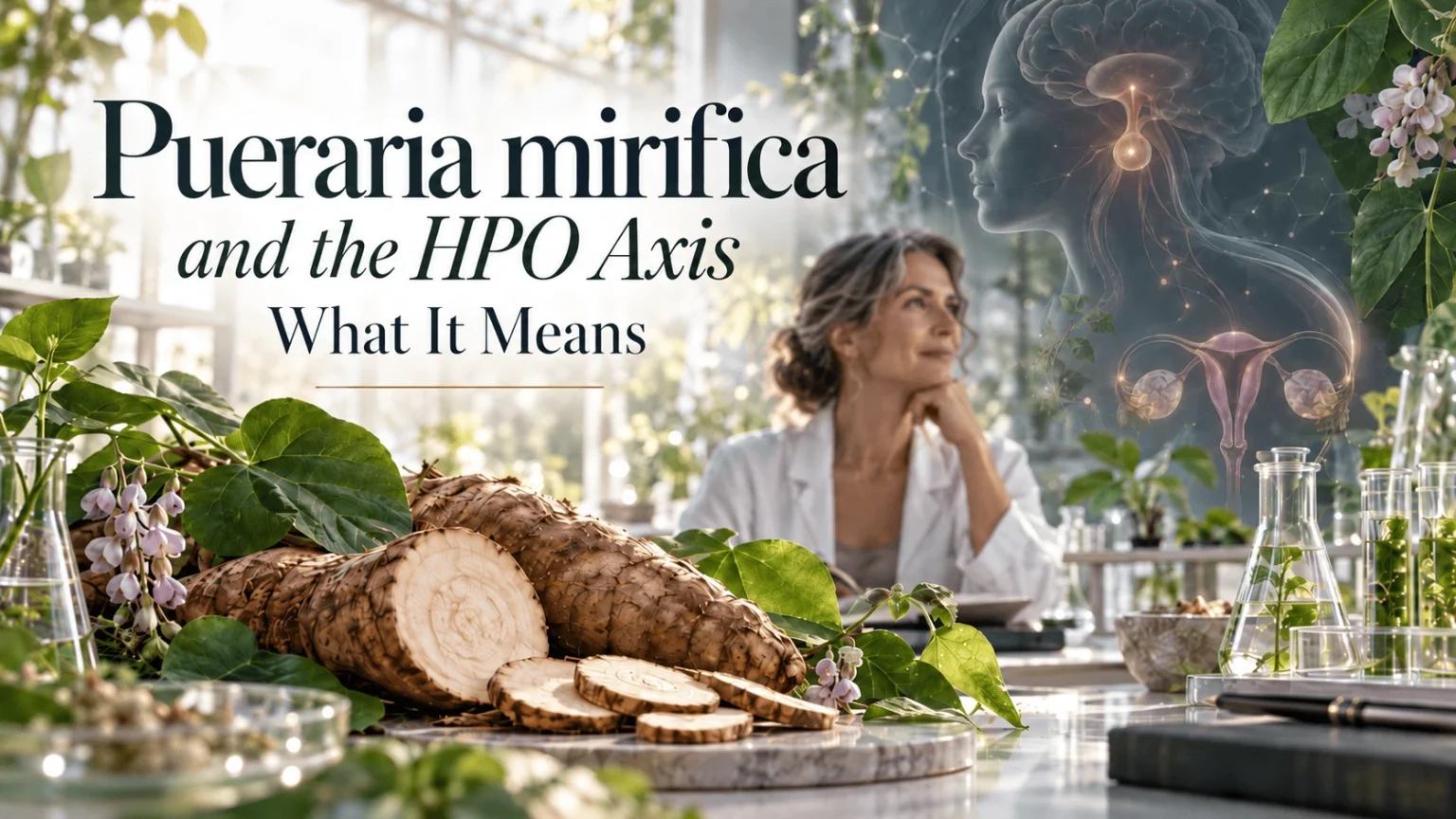
The hypothalamic-pituitary-ovarian (HPO) axis coordinates female reproductive
hormones through communication between the hypothalamus, pituitary gland, and
ovaries. Pueraria mirifica contains phytoestrogens that interact with estrogen
receptors involved in HPO feedback, so responses may vary with reproductive
stage, dose, timing, and individual hormonal patterns.
Key takeaways
-
The HPO axis coordinates GnRH, FSH, LH, estrogen, and progesterone to
regulate ovarian function and the menstrual cycle.
-
Pueraria mirifica contains phytoestrogens that can interact with
estrogen receptors involved in hypothalamic and pituitary feedback.
-
Some studies in menopausal women have observed changes in FSH levels,
which may reflect estrogenic activity within the HPO system.
-
Responses to Pueraria mirifica may vary across premenopause, perimenopause,
and postmenopause as the hormonal environment changes.
-
Pueraria mirifica acts within a connected hormonal signalling system,
rather than affecting individual estrogen-sensitive tissues in
isolation.
When a
healthcare provider talks about female hormonal health, they often refer to the
HPO axis without much explanation. If you have never had it explained clearly,
this article is for you. HPO stands for hypothalamic-pituitary-ovarian, and the
axis it describes is the master control system for female reproductive hormonal
function. Understanding how it works, and how Pueraria mirifica interacts with
it, gives you a much more complete picture of what this herb is actually doing
in the body.
The HPO axis
is not just relevant during reproductive years. It governs hormonal balance
from puberty through menopause, and its disruption is behind most of the
hormonal symptoms that drive women to seek botanical support. Knowing where
Pueraria mirifica fits into this system is the difference between using it
intelligently and using it by trial and error.
How the HPO Axis Works: A Step-by-Step Overview
The system
begins in the hypothalamus, a small region at the base of the brain that acts
as the integrating centre for hormonal signalling. The hypothalamus produces a
hormone called gonadotropin-releasing hormone, or GnRH. This hormone is
released in pulses rather than continuously, and the frequency and amplitude of
those pulses determine how strongly the next step of the axis responds.
GnRH travels
a short distance to the pituitary gland, which sits just below the
hypothalamus. The pituitary responds to GnRH by releasing two gonadotropins:
follicle-stimulating hormone, or FSH, and luteinising hormone, or LH. FSH
stimulates the development of follicles in the ovaries, with each follicle
containing an egg. As follicles develop, they produce estradiol, the primary
form of estrogen in premenopausal women.
Rising
estradiol in the first half of the cycle, the follicular phase, feeds back to
the hypothalamus and pituitary in a process of negative feedback, slowing GnRH
and FSH release. But as estradiol reaches its peak just before ovulation,
something interesting happens: at high enough concentrations, estradiol
triggers positive feedback, causing a surge of LH. This LH surge triggers
ovulation, releasing the egg from the dominant follicle.
After
ovulation, the empty follicle transforms into the corpus luteum and begins
producing progesterone. Progesterone completes the negative feedback loop,
suppressing FSH and LH production and preventing another round of follicle
development during the luteal phase. If pregnancy does not occur, the corpus
luteum degenerates, progesterone drops, and the cycle resets.
Where Pueraria mirifica Enters the HPO System
Pueraria
mirifica contains phytoestrogenic compounds that bind to estrogen receptors,
including those in the hypothalamus and pituitary gland. The hypothalamus and
pituitary have estrogen receptors specifically because estrogen feedback is
central to how they regulate the cycle. When phytoestrogens occupy some of
these receptors, they introduce an additional estrogenic signal into the
feedback system.
In practical
terms, this means that Pueraria mirifica can influence GnRH pulse patterns and
the pituitary’s sensitivity to those pulses. The effect is generally mild
compared to endogenous estradiol because phytoestrogens are weaker agonists,
but it is not zero. For postmenopausal women whose estrogen levels have fallen
and whose pituitary FSH is consequently elevated, phytoestrogen supplementation
may partially reduce FSH levels as the pituitary receives some degree of
estrogenic feedback.
This
FSH-lowering effect has been observed in some clinical studies on Pueraria
mirifica in menopausal women and is considered one measure of the herb’s
estrogenic activity in vivo. A meaningful reduction in FSH suggests genuine
estrogen receptor activation in the hypothalamic-pituitary system, which is consistent
with the herb’s known phytochemistry.
For
premenopausal women, the interaction with the HPO axis is more nuanced. Because
the endogenous estradiol system is already functioning, adding a
phytoestrogenic compound to the mix introduces additional signals that the axis
must integrate. Whether this shifts the cycle in meaningful ways depends on the
dose, the timing within the cycle, and individual HPO axis sensitivity.
What This Means for Practical Use
For
postmenopausal women, where the ovarian component of the HPO axis has
essentially ceased its cyclic function, Pueraria mirifica primarily provides
central and peripheral estrogenic support without the cyclic complexity. The
phytoestrogens act on estrogen receptors throughout the body, including in the
hypothalamus, to partially compensate for the loss of ovarian estrogen
production. This is the most straightforward application of the herb and the
one with the most direct mechanistic support.
For
perimenopausal women, whose hormonal patterns are already fluctuating as the
ovaries become less responsive, Pueraria mirifica supplementation is more
complex. The irregularity of the perimenopausal HPO axis means that the
response to phytoestrogen supplementation can vary month to month. Some women
find it helpful for evening out the most extreme highs and lows of the
perimenopausal hormonal swings. Others find the interaction less predictable.
For
premenopausal women using Pueraria mirifica for skin support or other
non-hormonal reasons, the doses typically involved are lower and the HPO
interaction is correspondingly gentler. Many premenopausal women use the herb
without noticing any changes to their menstrual cycle, while others report mild
cycle length changes. Awareness of the HPO connection is useful so that any
cycle changes are interpreted in the right context.
The key
practical takeaway is that Pueraria mirifica is not acting on the skin, bones,
and other target tissues in isolation. It is entering a connected signalling
system. Taking a dose is not like applying a topical compound only to the
target tissue. It is introducing a hormonal signal that the entire HPO axis
will process and respond to.
Respecting the System You Are Working With
Pueraria
mirifica HPO axis interactions are what make this herb both powerful and worth
approaching thoughtfully. The same properties that make it genuinely effective
for hormonal support also mean that it is interacting with one of the most
sophisticated regulatory systems in the human body.
Using it with some understanding of this system, rather than simply as a supplement you saw in an article, puts you in a much better position to use it effectively and to notice and interpret what is happening in your body as a result. The HPO axis is designed to be adaptable and resilient, but it also responds to what you give it. Give it quality information through quality supplementation, and it tends to respond well.