Herbs
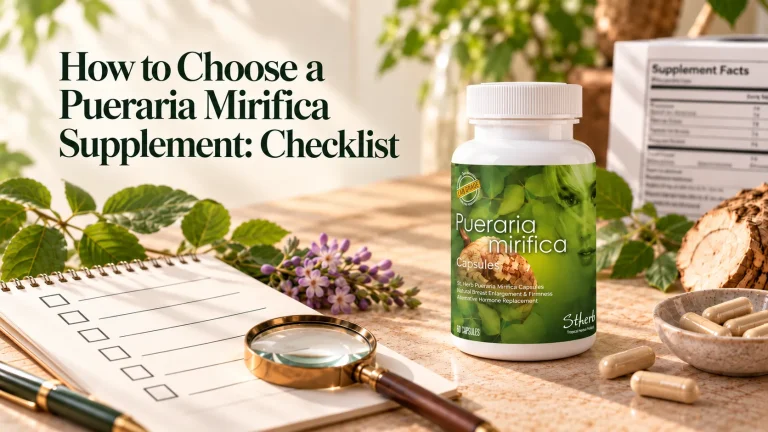
How to Choose a Pueraria Mirifica Supplement: Checklist
A 10-point label checklist for choosing a genuine Pueraria Mirifica supplement, from species name to certification.

What Pueraria mirifica is used for, and how strong the evidence is for each use: human studies, animal studies, lab research and traditional use.
Pueraria mirifica is a Thai plant root traditionally used for rejuvenation, and today mostly for menopause-related concerns. Small human studies have reported changes in menopausal symptom scores, vaginal health and a bone turnover marker. Evidence for skin is thin, hair is lab-only, and breast growth has no human trial.
Pueraria mirifica, called white Kwao Krua in Thailand, is a tuberous root. In Thai tradition the powdered root has been used in rejuvenating preparations for both women and men, according to a review of its medical applications. Today most products, and most research, focus on women around menopause. If you are new to the plant, start with What Is Pueraria Mirifica?.
Its effects are attributed to phytoestrogens, plant compounds that can act on estrogen receptors. They include miroestrol and deoxymiroestrol, which are largely unique to this plant, per a 2022 review in the Thai Journal of Pharmaceutical Sciences.
This article sorts each use by how strong the evidence is: human studies, animal studies, lab cells, or traditional use only. For the overall research picture, see Does Pueraria Mirifica Work?.
“Small human trial” in this table means dozens of people for a few months. Every row is labeled by who or what was studied, because a result in a rat or a cell dish is not a result in a person.
| Use | Evidence level | Studies | Links |
|---|---|---|---|
| Menopausal symptom scores | Humans, small trials | A trial in 52 women over 6 months, and an open-label trial in 37 women over 6 months (no placebo group) | 52-woman trial | 37-woman trial |
| Vaginal dryness and vaginal health | Humans (oral and gel), animals (gel) | An oral trial in 71 women over 24 weeks, a gel trial in 72 women, and a gel study in postmenopausal macaques | oral trial | gel trial | macaque study |
| Bone turnover marker | Humans, one trial | 71 women over 24 weeks. A lab marker changed. Bone density and fractures were not measured. | 2008 trial abstract |
| Skin wrinkles and moisture | Humans, very small, plus a company-sponsored test | A cream study with 9 participants, and a company press release describing a 28-day serum test with 42 volunteers | cream study | press release |
| Hair growth | Lab cells only. No human trial found. | Human hair-follicle cells in a dish, with one result positive and one pilot showing no effect | cell study | follicle pilot |
| Breast size or growth | Animals and traditional use. No human trial found. | Mouse and rat research on breast tissue growth. A clinical overview says no literature supports breast enlargement use. | Drugs.com overview | animal research review |
| Blood lipids | Humans, no clear benefit | In 71 women, triglycerides rose by 15 percent from baseline in both the herb and placebo groups | 2008 trial abstract |
| Cancer risk or protection | Animals, mixed. No human data. | In cancer-primed rats, the herb increased mammary cell growth and promoted tumors | rat study |
| Rejuvenation | Traditional use | Powdered root used in Thai rejuvenating preparations for women and men | review of medical applications |
For the full library of studies, see our Pueraria Mirifica research library.
This is the best-studied use, though “best-studied” still means small. A trial in 52 women who had had a hysterectomy compared two daily amounts over 6 months and reported lower menopausal symptom scores. An open-label trial in 37 perimenopausal women, with no placebo group, also reported lower scores over 6 months, and listed breast pain, vaginal discharge or bleeding and headache among the effects reported.
Context matters. Phytoestrogens as a group have a mixed record: Cochrane’s review of 43 trials with 4,084 women found no clear overall benefit for hot flushes from phytoestrogen products compared with placebo, although genistein-rich extracts looked worth studying further. A 2026 review of Pueraria mirifica research points to small samples, short follow-up and extracts that differ between studies, and Drugs.com describes the menopause data as limited and of poor quality.
Pueraria mirifica is not a replacement for medical hormone therapy, and nothing here says otherwise. If hot flushes or sleep problems are disrupting your life, a doctor can go through your options with you.
A randomized, double-blind, placebo-controlled trial in 71 postmenopausal women reported lower vaginal dryness symptoms and better markers of vaginal tissue health after 24 weeks of oral capsules. A trial of a topical gel in 72 postmenopausal women reported better vaginal blood flow and vaginal health index scores than a placebo gel. In an animal study, a topical cream improved vaginal tissue measures in postmenopausal macaques. The macaque result tells us about vaginal tissue in that species, not about breast or facial skin.
A study of a Pueraria mirifica anti-wrinkle cream with 9 participants reported smaller wrinkle surface and volume after 7 and 14 days, with moisturizing similar to comparison creams. That is a very small test. A company press release describes a 28-day serum test with 42 volunteers, sponsored by the extract’s maker. A press release is not a peer-reviewed paper, so treat it as a claim to check, not as proof.
Hair research is in lab cells only. A cell study found that Pueraria mirifica extract increased the growth of human hair follicle dermal papilla cells in a dose-dependent way, while an older pilot on cultured human hair follicles found no effect from the extract. We found no human trial of Pueraria mirifica for hair.
This is the use readers ask about most, and the one where the gap between marketing and evidence is widest. Here is what is known. Older research in mice and rats, described in a university thesis review, reported mammary duct growth. In people, a 24-week trial in 71 postmenopausal women found no significant difference between the herb and placebo in adverse effects on breast tissue. That is a safety finding, not a growth finding.
Here is what is not known. No published human trial we found measured breast size or shape. A clinical overview on Drugs.com says plainly that there is no literature to support breast enlargement use, even though it is a common marketing claim. So, any promise of a specific result is beyond what the research shows.
If you decide to use a breast product, read its label and ask your doctor first. St.Herb sells Breast Capsules, and the label on the pack is the place to check directions.
Pueraria mirifica acts like an estrogen in some tissues, so it is not for everyone. According to Drugs.com, it should be avoided or used only with medical supervision if you are pregnant or breastfeeding, have a hormone-sensitive cancer, a history of blood clots or liver disease, or take hormonal birth control or other hormone medicines.
Reported effects in trials include breast tenderness, headache and spotting. For the full rundown of side effects and when to stop, read our Pueraria Mirifica side effects and safety guide. And if you are considering it for any reason beyond menopause, talk to a doctor first.
Traditionally, it has been used in Thai rejuvenating preparations, per this review of medical applications. Today it is mostly used by women around menopause, for symptoms, vaginal comfort and general wellness. The strength of evidence differs for each use, as the table above shows.
The best-supported findings are lower menopausal symptom scores in small trials, such as this trial in 52 women, and better vaginal comfort measures in a trial in 71 women. These are small, short studies, so “benefit” here means “was associated with,” not “guaranteed.”
It was associated with lower symptom scores in small trials, but the wider field of phytoestrogens has a mixed record. Cochrane’s review of 43 trials with 4,084 women found no clear overall benefit for hot flushes from phytoestrogen products compared with placebo. It is not a replacement for medical hormone therapy, and you should ask your doctor about your options.
No. We found no published human trial that measured it. A clinical overview on Drugs.com says there is no literature to support breast enlargement use, even though it is a common marketing claim. Any promise of a specific result goes beyond the research.
The evidence is thin. For skin, a study with 9 participants tested a cream. For hair, the research is in cells in a dish only, with a cell study and a pilot that found no effect. Neither has been tested in a proper human trial for hair.
Pregnant or breastfeeding women, anyone with a hormone-sensitive condition, and people on hormone medicines should avoid it unless a doctor says otherwise, according to Drugs.com. Our safety guide has the full list.
Explore the product this article talks about — crafted from research-backed Thai botanicals.
A 10-point label checklist for choosing a genuine Pueraria Mirifica supplement, from species name to certification.
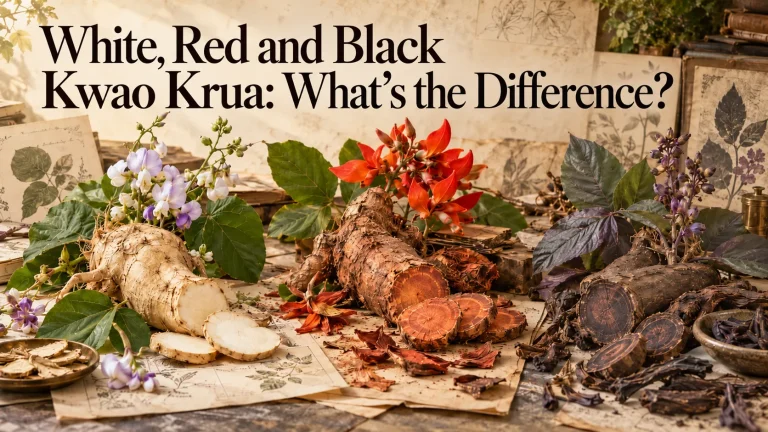
White, red and black Kwao Krua are three different Thai plants, not three strengths of one herb. Here's how to tell them…
There is no single Pueraria Mirifica dosage. Here is how to read the label, compare forms, and dose safely.