Herbs
White, Red and Black Kwao Krua: What’s the Difference?
White, red and black Kwao Krua are three different Thai plants, not three strengths of one herb. Here's how to tell them…

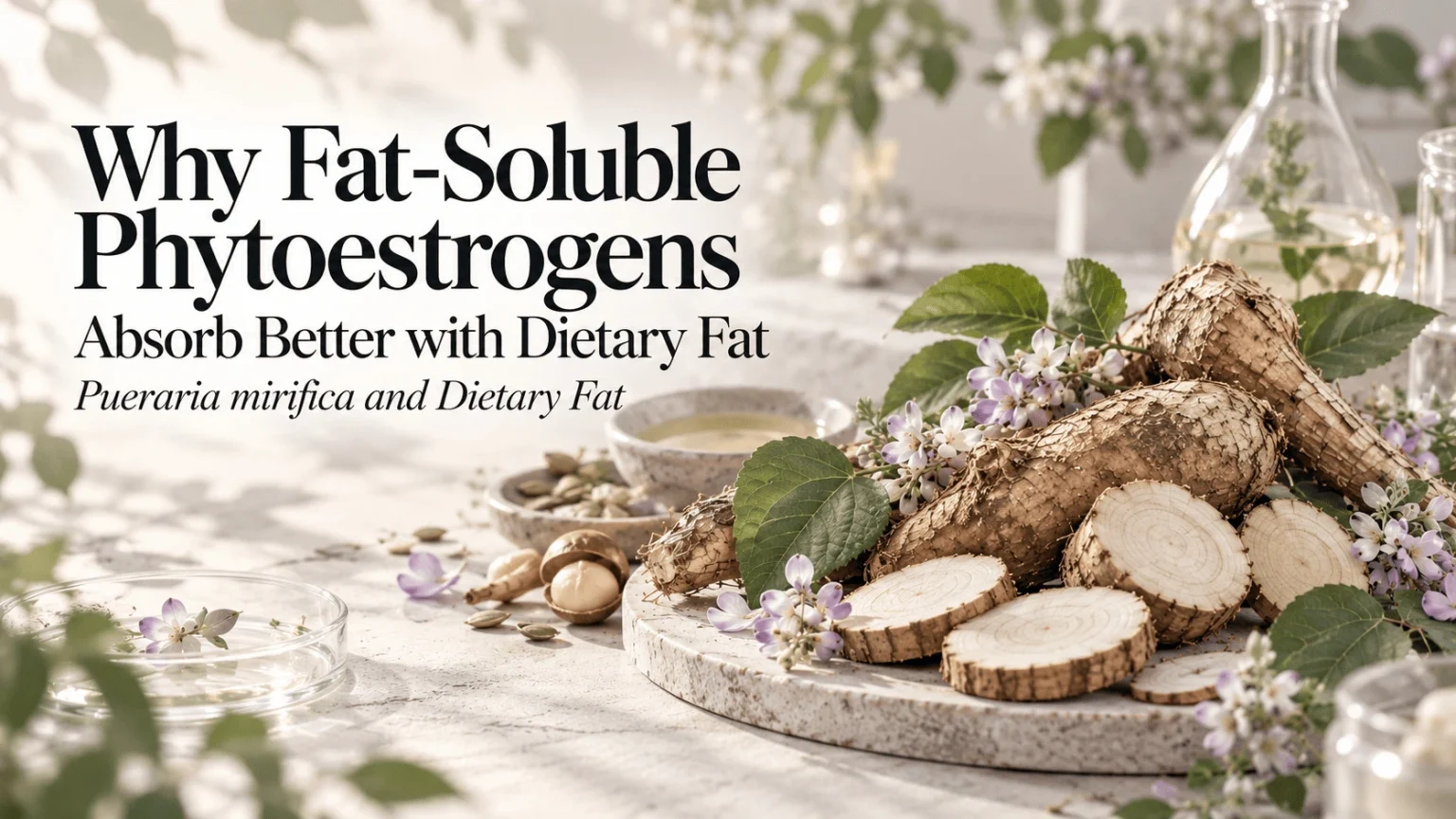
Taking Pueraria mirifica with a meal containing dietary fat may improve absorption of fat-soluble phytoestrogenic compounds by supporting bile release and micelle formation in the intestine. Evidence is stronger for related isoflavones than for Pueraria mirifica specifically, so taking it with a normal fat-containing meal is best viewed as a practical way to support absorption rather than a guarantee of a specific increase.
If you take your Pueraria mirifica capsule with a glass of water on an empty stomach before leaving the house in the morning, you may be leaving a meaningful portion of its potential benefit on the table. Not because the herb is low quality or because the dose is wrong, but because the route by which phytoestrogens travel from your gut into your bloodstream is significantly affected by whether there is dietary fat present at the same time.
This is not complicated chemistry. It follows logically from the fat-soluble nature of many phytoestrogenic compounds. Understanding it takes about five minutes and can meaningfully improve the consistency of your results without changing anything about the supplement itself.
Compounds that dissolve in water are absorbed through the gut lining relatively directly. They enter the intestinal cells and pass into the bloodstream through aqueous channels. Most vitamins, minerals, and many amino acids work this way.
Fat-soluble compounds work differently. They do not dissolve in water, so they cannot simply diffuse across the water-based environment of the gut lumen and into intestinal cells on their own. Instead, they need to be packaged into structures called micelles, which are tiny spherical particles made of bile salts and dietary fat. Micelles solubilise fat-soluble compounds and ferry them to the surface of intestinal epithelial cells, where absorption can occur.
The rate-limiting step in this process is the availability of bile and dietary fat. When you eat a meal containing fat, the gallbladder contracts and releases bile into the small intestine. This bile contains bile salts that are essential for micelle formation. Without dietary fat in the gut, this release is minimal and micelle formation is limited.
Phytoestrogens in Pueraria mirifica, particularly the diarylheptanoid and isoflavone compounds, have meaningful fat solubility. Their chemical structure includes aromatic rings and hydrophobic regions that interact with dietary fat and bile in the way described above. Taking them without fat present reduces the efficiency of this packaging and delivery process.
The most rigorous research on this topic has been done with soy isoflavones, which are structurally related to the phytoestrogens in Pueraria mirifica. Studies comparing isoflavone absorption in fasted versus fed conditions have consistently found higher peak plasma concentrations and greater total bioavailability when the isoflavones were taken with a meal.
One pharmacokinetic study found that the maximum plasma concentration of genistein, a well-studied soy isoflavone, was approximately 30 to 40 percent higher when taken with a meal containing fat compared to a fasted state. The area under the plasma concentration curve, which reflects total absorption over time, was also significantly greater with food. These are not trivial differences. They represent a substantial portion of the compound that either reaches systemic circulation or does not, depending entirely on what was consumed at the same time.
The type of fat also appears to matter to some degree. Long-chain fatty acids from animal fats and many plant oils stimulate more robust bile release and micelle formation than medium-chain fatty acids. For practical purposes, eating a meal with normal proportions of dietary fat, not a meal specifically designed to be high in fat, is sufficient to support improved phytoestrogen absorption.
Less research has been done specifically on Pueraria mirifica absorption with versus without food, and the specific compounds in Pueraria mirifica have somewhat different fat solubility profiles than soy isoflavones. But the underlying chemistry is similar enough that the principle applies. Products based on lipid-complexed or phosphatidylcholine-bound phytoestrogens are formulated specifically to address this absorption challenge, and they do show improved bioavailability in studies.
The most immediately actionable takeaway from this absorption research is simple: take your Pueraria mirifica supplement with a meal that contains some dietary fat. This does not need to be a large or high-fat meal. A meal with avocado, eggs, olive oil, nuts, meat, fish, or dairy provides adequate fat to stimulate meaningful bile release and support micelle formation.
The timing within the meal matters less than the presence of fat. Whether you take the capsule at the beginning, middle, or end of the meal, as long as the fat is present in the gut at approximately the same time, the absorption benefit is obtained. Taking the capsule thirty minutes to an hour before an entirely fat-free meal is less effective than taking it with a very small amount of fat.
If you typically fast in the morning and take supplements before your first meal of the day, shifting Pueraria mirifica to your first meal will almost certainly improve your results. For people who take their supplement at lunch or dinner, the absorption benefit is likely already being obtained by default, assuming those meals contain any fat at all.
Certain individuals with fat malabsorption conditions, including those with bile duct issues, inflammatory bowel disease, or a history of gallbladder removal, may have impaired fat-soluble absorption regardless of dietary fat intake. For these individuals, lipid-complexed supplement forms or enhanced delivery preparations may offer better results than standard capsule forms.
Fat soluble phytoestrogen absorption with dietary fat is one of the clearest examples of a basic supplement science principle that most product labels still fail to explain adequately. You are not getting less from your herb because of some hormonal issue or quality problem. You may simply be taking it under conditions that make effective absorption difficult.
Taking Pueraria mirifica with food containing fat is a simple, free optimisation that has real mechanistic support. It costs nothing to change and has the potential to meaningfully improve the consistency of your results. Start there before considering any other adjustments to your supplement routine.
Explore Stherb’s Thai herbal skincare and supplements, crafted from research-backed botanicals.
White, red and black Kwao Krua are three different Thai plants, not three strengths of one herb. Here's how to tell them…
There is no single Pueraria Mirifica dosage. Here is how to read the label, compare forms, and dose safely.
Pueraria Mirifica can cause side effects because it contains biologically active phytoestrogens that interact with estrogen receptors. Reported effects include breast tenderness,…