
Wellness
Does Pueraria Mirifica Cause Weight Gain?
Weight on the scale is not the same as body fat. See what research says about Pueraria Mirifica, water retention and where…

A Thai herb traditionally linked to uterine comfort and postpartum recovery: how Curcuma comosa differs from common turmeric, and what the research so far actually shows.
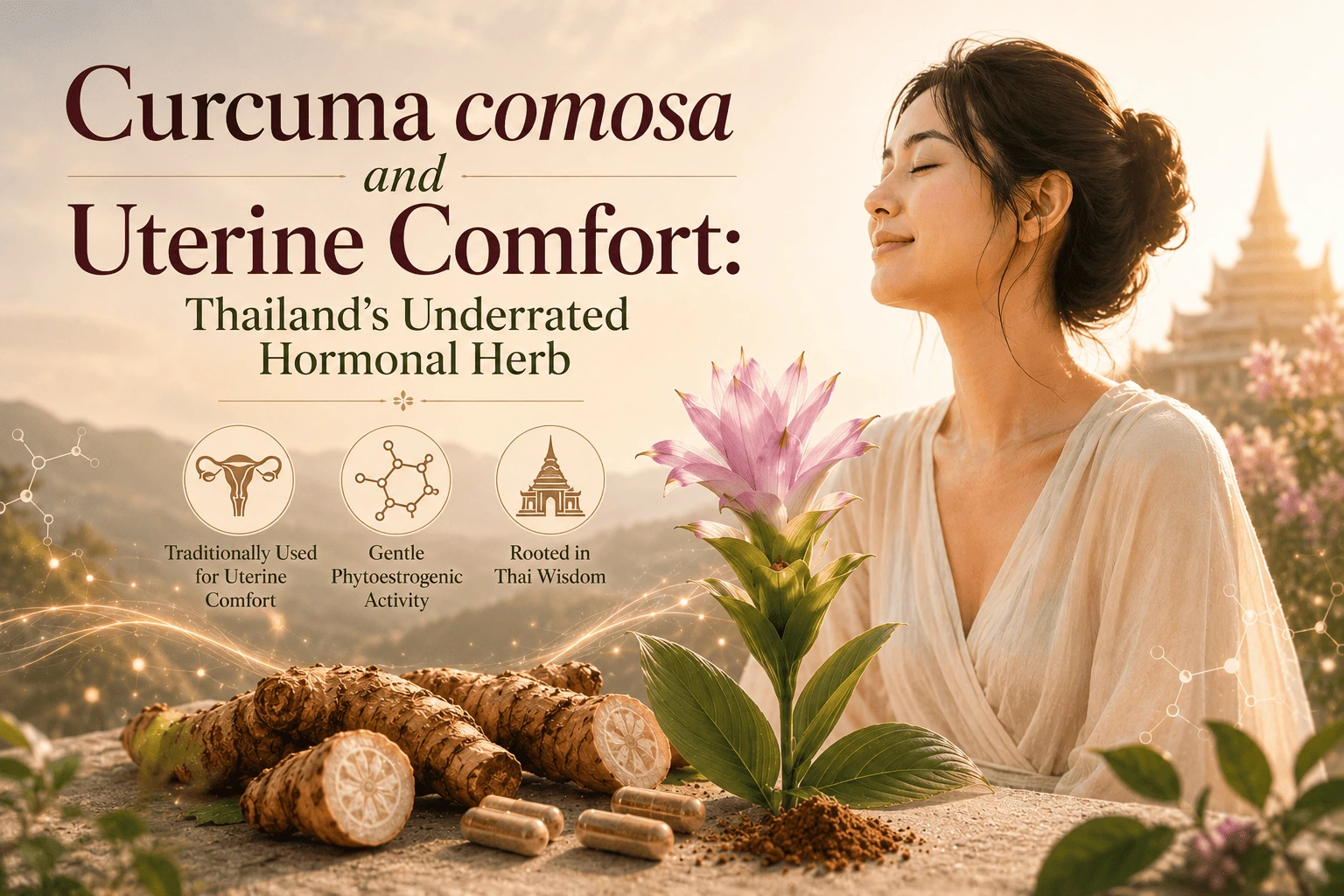
If you follow Thai herbal wellness at all, you have probably come across Curcuma longa, the common turmeric that has become a global wellness staple. But in Thailand, there is another member of the Curcuma family that has been quietly valued by traditional practitioners for generations, one that most people outside Southeast Asia have never heard of. That herb is Curcuma comosa, and its primary reputation is closely tied to uterine health and female hormonal comfort.
What makes Curcuma comosa particularly interesting is that its mechanism of action appears to be genuinely different from its better-known relatives. While Curcuma longa is prized mainly for curcumin and its anti-inflammatory effects, Curcuma comosa contains a distinct set of diarylheptanoids that interact with estrogen pathways in ways that are still being studied. For women dealing with menstrual discomfort or uterine-related complaints, this is a herb worth understanding properly.
Curcuma comosa is a rhizomatous plant native to Thailand and parts of Southeast Asia. It belongs to the same Zingiberaceae family as ginger, galangal, and turmeric, but it has a distinctly different chemical profile from Curcuma longa. While turmeric’s active compounds are primarily curcuminoids, Curcuma comosa’s most studied active compounds are diarylheptanoids, including a group sometimes referred to as comosins.
These diarylheptanoids have shown weak estrogenic activity in laboratory settings, meaning they can bind to estrogen receptors at low affinity and produce mild hormonal signalling. This is part of what makes Curcuma comosa relevant to women’s hormonal health rather than simply being an anti-inflammatory herb like its more famous cousin.
| Feature | Curcuma comosa | Curcuma longa |
|---|---|---|
| Plant family | Zingiberaceae | Zingiberaceae |
| Main compounds discussed | Diarylheptanoids | Curcuminoids |
| Traditional focus | Uterine health, menstrual comfort, and postpartum formulas | General wellness and anti-inflammatory applications |
| Hormonal relevance | Weak estrogenic activity has been studied | Primarily known for curcumin and anti-inflammatory effects |
In Thailand, Curcuma comosa has traditionally been included in postpartum herbal formulas used by women in the weeks after childbirth. It has also been used in formulas aimed at easing menstrual discomfort and supporting uterine recovery. Traditional Thai medicine has a long history of classifying herbs according to their affinity for specific organs, and Curcuma comosa has long been associated with the uterus and reproductive organs.
The research that has accumulated over the past two decades gives some scientific weight to these traditional uses. Studies conducted primarily in Thailand have examined the herb’s effect on uterine muscle tone, smooth muscle relaxation, and estrogen receptor binding. The results are not yet at the level of large-scale clinical trials, but the mechanistic data is consistent enough to take the traditional claims seriously.
One of the most studied aspects of Curcuma comosa is its potential to reduce uterine smooth muscle spasms. Menstrual cramps are caused largely by prostaglandin-driven contractions of the uterine wall, and anything that influences smooth muscle tone or prostaglandin activity can affect menstrual comfort.
Research from Mahidol University and other Thai institutions has found that extracts of Curcuma comosa can relax uterine smooth muscle in animal models. The proposed mechanism involves both the weak estrogenic activity of its diarylheptanoids and possible modulation of calcium channels that govern muscle contraction. While human trials remain limited, the smooth muscle relaxation findings have been consistent enough across multiple studies to be considered a meaningful signal.
There is also evidence suggesting that Curcuma comosa may support bone density, which is particularly relevant for women experiencing perimenopausal hormonal shifts. Studies in ovariectomised rats, which are used as a model for postmenopausal estrogen loss, have found that Curcuma comosa supplementation partially preserved bone mineral density. This aligns with the traditional view of the herb as supportive during hormonal transitions, not just for acute menstrual comfort.
It is worth being clear that most of this research is preclinical, meaning it has been done in cells or animals rather than large human trials. The herb’s estrogenic activity is weak compared to stronger phytoestrogens like those in Pueraria mirifica. But this gentler hormonal touch may actually make it well-suited for women who want mild support rather than a stronger phytoestrogenic intervention.
Traditional Thai practitioners have typically used Curcuma comosa as part of compound formulas rather than as a standalone herb. It appears in herbal steam baths, postpartum tonics, and tablet formulas that combine multiple warming and hormone-supportive herbs. This reflects a broader principle in Thai traditional medicine: herbs work better in combination, and each formula is designed to address a pattern of symptoms rather than a single compound.
Postpartum use is perhaps the longest-established application. In rural Thai communities, new mothers traditionally undergo a recovery period known as yu fai, which includes heat therapy, dietary adjustment, and the use of specific herbal formulas. Curcuma comosa has been part of this tradition for generations, used to support uterine involution, the process by which the uterus returns to its pre-pregnancy size and tone.
For women experiencing menstrual irregularity or significant monthly discomfort, traditional practitioners have used Curcuma comosa alongside herbs like ginger and Curcuma aeruginosa in warming formulas. The warming classification in Thai medicine refers to herbs believed to stimulate circulation and energy flow rather than to their literal temperature.
Modern commercial applications of Curcuma comosa have typically delivered it in capsule form as a standardised extract. Dosing in traditional formulas varies considerably, which makes direct comparisons with modern supplement research tricky. If you are considering Curcuma comosa as part of your herbal routine, looking for products that specify their diarylheptanoid content or are produced under quality-controlled conditions is a reasonable starting point.
Curcuma comosa uterine comfort is not a marketing claim invented to fill a shelf. It is grounded in centuries of Thai traditional medicine and supported by a growing, though still developing, body of scientific research. The herb fills a specific niche that common turmeric does not address, particularly for women seeking gentle phytoestrogenic support and smooth muscle relaxation.
For anyone interested in Thai botanical medicine beyond the most widely marketed herbs, Curcuma comosa is one of the clearest examples of a plant with deep traditional roots and real mechanistic plausibility. It deserves more attention than it currently receives outside Thailand, and the research community appears to agree. More human studies would help, but the foundations are already well-established.
For a broader look at how traditional Thai botanicals are used in women’s wellness, explore St.Herb’s guide to Thai herbs for women’s health.
In traditional Thai medicine, Curcuma comosa has been associated with uterine health, menstrual comfort, postpartum formulas, and reproductive support.
No. Both belong to the Zingiberaceae family, but Curcuma longa is known primarily for curcuminoids, while Curcuma comosa is studied mainly for its diarylheptanoids.
Traditional Thai medicine has long associated the herb with the uterus, while research has examined its effects on uterine smooth muscle, estrogen receptor activity, and mechanisms involved in muscle contraction.
Its diarylheptanoids have shown weak estrogenic activity in laboratory settings, which is one reason the herb has been studied in relation to women’s hormonal health.
Much of the research discussed in this article is preclinical and has been conducted in cells or animal models. Large-scale human clinical trials remain limited.
Explore St.Herb’s women’s health range and discover more traditional Thai botanicals for female wellness and hormonal support.
Explore Stherb’s Thai herbal skincare and supplements, crafted from research-backed botanicals.
Weight on the scale is not the same as body fat. See what research says about Pueraria Mirifica, water retention and where…
White, red and black Kwao Krua are three different Thai plants, not three strengths of one herb. Here's how to tell them…
There is no single Pueraria Mirifica dosage. Here is how to read the label, compare forms, and dose safely.