Herbs
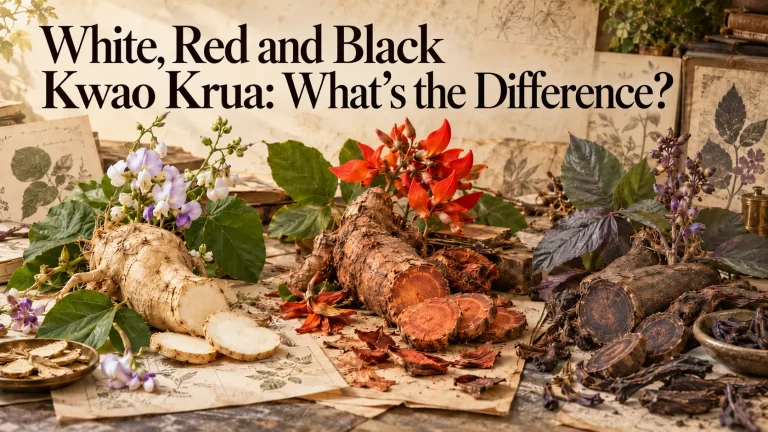
White, Red and Black Kwao Krua: What’s the Difference?
White, red and black Kwao Krua are three different Thai plants, not three strengths of one herb. Here's how to tell them…


Pueraria mirifica (White Kwao Krua) is widely recognized for its potent phytoestrogenic effects, traditionally used in Thai herbal medicine for women’s wellness and rejuvenation. While much attention is given to miroestrol and deoxymiroestrol, two powerful estrogenic compounds, another significant bioactive molecule is puerarin, an isoflavone glycoside with extensive pharmacological potential.
This article explores the science, benefits, and mechanisms of puerarin, supported by current research.
Puerarin is a naturally occurring isoflavone primarily found in several Pueraria species, including Pueraria mirifica and Pueraria lobata. It is known for its:
Although not as estrogenically potent as miroestrol or deoxymiroestrol, puerarin remains a crucial compound contributing to P. mirifica’s overall health effects.
Puerarin exhibits mild phytoestrogenic activity, interacting with estrogen receptors (ER-α and ER-β) and contributing to hormonal balance.
A study published in Phytomedicine highlighted that puerarin demonstrates selective estrogen-receptor modulation, helping regulate hormone-related pathways without the risks associated with synthetic estrogen therapies (Kang et al., 2017).
While puerarin is not the main compound responsible for breast enhancement, it plays a supportive estrogen-modulating role.
Puerarin contributes to skin elasticity, hydration, and overall dermal health through collagen-supportive mechanisms.
Research shows puerarin enhances fibroblast function and protects skin cells from oxidative stress (Zhang et al., 2020). This makes it a valuable component in topical formulations targeting firmness and rejuvenation.
Thus, puerarin adds significant cosmetic value to P. mirifica–based skincare products.
Puerarin demonstrates strong antioxidant properties, helping neutralize free radicals and reduce inflammation.
A study in Journal of Ethnopharmacology confirmed puerarin’s free radical–scavenging ability and its role in protecting tissues from oxidative injury (Liu et al., 2013).
These systemic antioxidant effects make puerarin valuable beyond hormone-related applications.
Puerarin has shown remarkable neuroprotective potential in both animal and cellular models.
Studies indicate that puerarin improves cerebral blood flow, supports mitochondrial function, and reduces neural inflammation (Zhu et al., 2015).
Although human clinical trials are still limited, the early evidence is promising.
One of the best-researched effects of puerarin is its vascular and metabolic support.
Clinical and preclinical studies show that puerarin may:
A review in Fitoterapia described puerarin as a multifunctional compound with demonstrated vascular benefits (Turner et al., 2020).
These actions complement the lipid-modulating phytoestrogens in P. mirifica.
Pueraria mirifica contains multiple bioactive molecules, including:
Puerarin enhances the herb’s overall synergistic effect, contributing to:
This synergy explains why whole-herb extracts may be more effective than isolated compounds.
Puerarin is generally well-tolerated when consumed in natural extract form.
However:
Always choose reputable, standardized P. mirifica products.
Puerarin is a scientifically significant compound found in Pueraria mirifica, contributing to the herb’s hormonal, antioxidant, cognitive, and skin benefits. While not the strongest estrogenic molecule in the plant, its broad pharmacological effects make it an important component of Pueraria mirifica’s wellness profile.
As research continues to expand, puerarin is emerging as a natural compound with diverse health-supportive properties and therapeutic potential.
Kang, S. C., et al. (2017). Estrogenic activity of miroestrol and deoxymiroestrol isolated from Pueraria mirifica. Phytomedicine, 25, 84–91. https://doi.org/10.1016/j.phymed.2016.12.018
Liu, C. M., Zheng, G. H., Ming, Q. L., Sun, J. M., & Cheng, C. (2013). Protective effect of puerarin against oxidative stress–induced cell injury. Journal of Ethnopharmacology, 150(1), 190–198.
Turner, J., et al. (2020). A comprehensive review on Pueraria: Insights on its chemistry and health-benefits. Fitoterapia, 147, 104799. https://doi.org/10.1016/j.fitote.2020.104799
Zhang, T., et al. (2020). Puerarin enhances skin fibroblast function and protects against aging-related oxidative stress. Phytotherapy Research, 34(2), 394–403.
Zhu, X., Xia, M., & Wang, H. (2015). Neuroprotective effects of puerarin on oxidative stress and mitochondrial dysfunction. Neuroscience Letters, 587, 76–81.
Explore our website for upcoming content: Click Here
Explore Stherb’s Thai herbal skincare and supplements, crafted from research-backed botanicals.
White, red and black Kwao Krua are three different Thai plants, not three strengths of one herb. Here's how to tell them…
There is no single Pueraria Mirifica dosage. Here is how to read the label, compare forms, and dose safely.
Pueraria Mirifica can cause side effects because it contains biologically active phytoestrogens that interact with estrogen receptors. Reported effects include breast tenderness,…