Herbs
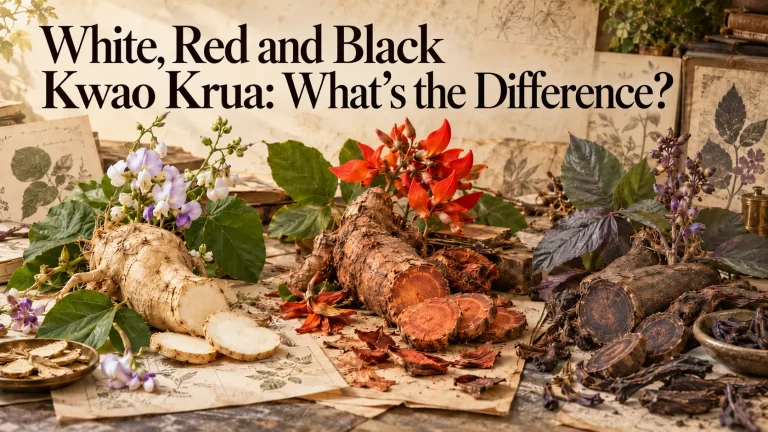
White, Red and Black Kwao Krua: What’s the Difference?
White, red and black Kwao Krua are three different Thai plants, not three strengths of one herb. Here's how to tell them…

The Pueraria genus, belonging to the Fabaceae family, includes several leguminous plants native to Asia. Among them, Pueraria mirifica has gained global recognition for its rejuvenating and estrogenic properties. However, it is often confused with other species such as Pueraria lobata (kudzu) and Pueraria candollei. Let’s see the comparison between Pueraria mirifica and other Pueraria species.
Although these plants share botanical similarities, their phytochemical compositions, biological activities, and clinical applications differ significantly. This article explores how P. mirifica stands apart from its relatives, supported by scientific research.
(Suthon et al., 2020; Cherdshewasart & Sutjit, 2008)
The unique properties of P. mirifica stem from its exclusive phytoestrogens:
According to Cherdshewasart et al. (2008), the estrogenic potency of P. mirifica can be up to 1,000 times higher than P. lobata, depending on extract concentration and preparation method.
| Activity | Pueraria mirifica | Pueraria lobata | Pueraria candollei |
|---|---|---|---|
| Estrogenic effect | Very strong (miroestrol, deoxymiroestrol) | Mild (puerarin) | Moderate |
| Bone protection | Proven in animal and human trials (Soodvilai et al., 2006) | Limited data | Limited |
| Cardiovascular benefits | Improves lipid profiles (Laupattarakasem et al., 2009) | Supports vascular function | Unknown |
| Cognitive effects | Neuroprotective in aging models (Anukulthanakorn et al., 2016) | Antioxidant, anti-ischemic | Limited |
| Skin health | Promotes collagen and elasticity | Mild antioxidant | Mild |
Thus, P. mirifica stands out as the most potent estrogenic and anti-aging species, while P. lobata is better known for its metabolic and cardiovascular effects.
No comparable human data exists for P. candollei, suggesting it is less clinically relevant than P. mirifica.
Although P. mirifica demonstrates safety in short-term studies, its strong phytoestrogenic activity warrants caution among individuals with hormone-sensitive conditions. P. lobata, being weaker in estrogenic effects, poses fewer risks but also fewer hormonal benefits (Turner et al., 2020).
Product quality and dosage standardization remain essential to minimize risk.
While all Pueraria species share certain phytochemical similarities, only Pueraria mirifica contains miroestrol and deoxymiroestrol, giving it unique endocrine-modulating and rejuvenating properties.
In contrast, P. lobata and P. candollei offer general antioxidant and cardiovascular benefits but lack comparable hormonal efficacy.
Choosing the right Pueraria species depends on one’s goals: for hormonal balance and anti-aging, P. mirifica remains the gold standard supported by scientific research.
Explore our website for more content: Click Here
Explore Stherb’s Thai herbal skincare and supplements, crafted from research-backed botanicals.
White, red and black Kwao Krua are three different Thai plants, not three strengths of one herb. Here's how to tell them…
There is no single Pueraria Mirifica dosage. Here is how to read the label, compare forms, and dose safely.
Pueraria Mirifica can cause side effects because it contains biologically active phytoestrogens that interact with estrogen receptors. Reported effects include breast tenderness,…