Herbs
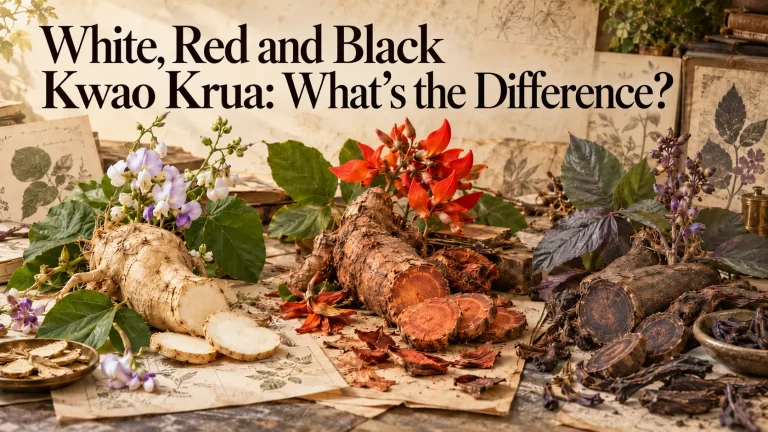
White, Red and Black Kwao Krua: What’s the Difference?
White, red and black Kwao Krua are three different Thai plants, not three strengths of one herb. Here's how to tell them…


Mucuna pruriens contains natural L-DOPA, a compound converted into dopamine in the body. Research has explored its relationship with neurological function, motivation, hormonal regulation, and male reproductive health, although individual responses may vary.
Mucuna pruriens is a tropical legume that grows in Thailand and across much of South and Southeast Asia. It goes by several common names, including velvet bean, cowhage, and in Thai herbal tradition, mat praaw. For centuries, practitioners of both Ayurvedic and Thai traditional medicine used preparations of Mucuna pruriens seeds for conditions relating to tremor, nerve health, male vitality, and mood. What those practitioners could not have known is that the mechanism behind many of these traditional uses involves a compound called L-DOPA, a precursor to dopamine that the bean contains in notable concentrations.
Modern research on Mucuna pruriens has validated many of its traditional applications and revealed a biochemical sophistication that makes this plant genuinely interesting beyond its historical reputation. The L-DOPA content in Mucuna pruriens connects to dopamine pathways in ways that are relevant to mood, motivation, reproductive health, and neurological function.
L-DOPA stands for levodopa, or 3,4-dihydroxy-L-phenylalanine. It is an amino acid that serves as the immediate biochemical precursor to dopamine in the brain and body. Dopamine itself cannot cross the blood-brain barrier, which is why L-DOPA is the clinically used form for conditions requiring dopamine restoration. L-DOPA, unlike dopamine, can cross from the bloodstream into the brain where it is then converted into dopamine by the enzyme DOPA decarboxylase.
Dopamine is one of the most important neurotransmitters in human physiology. It governs the brain’s reward and motivation circuits, controls voluntary movement through the basal ganglia, plays a central role in the regulation of the hypothalamic-pituitary axis, and influences the production of prolactin, growth hormone, and testosterone.
The clinical use of L-DOPA in medicine is well-established as the primary treatment for Parkinson’s disease, a condition characterised by the progressive loss of dopamine-producing neurons in the basal ganglia. Parkinson’s disease was actually being treated with Mucuna pruriens seed preparations in Ayurvedic medicine for centuries before the pharmacological mechanism was understood, which is a remarkable example of traditional medicine anticipating pharmaceutical science.
Mucuna pruriens seeds contain between 3.1 and 6.7 percent L-DOPA by weight in natural form, though this varies by variety and growing conditions. Standardised extracts can contain considerably higher concentrations. This is not trace amounts of a mildly active compound. It is a clinically meaningful concentration of a potent bioactive molecule.
In Thai traditional medicine, Mucuna pruriens was included in formulas aimed at supporting nerve strength, reducing involuntary movements, and building male sexual vitality. These applications, though described in the language of traditional energetic medicine rather than biochemistry, align well with what we now understand about dopamine’s role in both neurological function and reproductive hormonal regulation.
The male vitality connection is particularly well-supported by modern research. Dopamine is a critical regulator of the hypothalamic-pituitary-gonadal axis. Dopaminergic signals from the hypothalamus stimulate the release of gonadotropin-releasing hormone, which in turn drives LH and FSH secretion from the pituitary. LH then stimulates Leydig cells in the testes to produce testosterone. A herb that enhances dopaminergic tone can therefore support testosterone production through this regulatory cascade.
Clinical research supports this pathway in the context of male infertility. A study published in the journal Fertility and Sterility found that Mucuna pruriens treatment in infertile men over ninety days significantly increased sperm count, motility, and serum testosterone levels. The improvements in testosterone and LH were consistent with enhanced dopaminergic drive on the hypothalamic-pituitary axis.
The research also found reductions in psychological stress markers and improvements in antioxidant status within the seminal fluid, suggesting that Mucuna pruriens acts through multiple complementary mechanisms simultaneously rather than just through a single dopamine pathway.
The mood effects of Mucuna pruriens are worth addressing separately, because they are clinically relevant and often underappreciated in the herb’s popular reputation as primarily a male fertility supplement.
Dopamine underpins the brain’s motivation and reward systems through what is called the mesolimbic pathway. When dopamine signalling in this pathway is adequate, people experience motivation, curiosity, anticipation of reward, and the ability to initiate action. When it is chronically low, the experience is often one of flatness, low motivation, and difficulty finding pleasure in activities that used to feel engaging. This state is not the same as clinical depression, which involves serotonin, norepinephrine, and other neurotransmitters as well, but it shares significant overlap with its symptoms.
Traditional Thai practitioners described conditions that would now map to low dopaminergic tone as disorders of vitality or nerve weakness. Their treatment approach with Mucuna pruriens effectively addressed the biochemical reality without using that language. For modern users experiencing low motivation, reduced libido, or difficulty sustaining effort, Mucuna pruriens represents a botanical option with genuinely mechanistic support.
It is important to acknowledge that because Mucuna pruriens contains actual L-DOPA rather than simply L-DOPA precursors, it has a more potent mechanism than many herbal supplements. At standard supplemental doses, this is generally well-tolerated. At high doses or in individuals with sensitivity to dopaminergic compounds, side effects including nausea, vivid dreaming, and agitation are possible. Starting with lower doses and monitoring individual response is the sensible approach.
Mucuna pruriens L-DOPA dopamine herbal research has confirmed what traditional practitioners in Thailand and India observed through careful empirical use over centuries. This is a plant with real, potent, and well-characterised biochemical activity, not a mildly active botanical with primarily placebo effects.
For anyone interested in supporting dopaminergic health, male reproductive function, or neurological resilience through botanical means, Mucuna pruriens deserves a place in that conversation. Its traditional credibility and its modern research backing are unusually well-aligned, which makes it one of the more compelling herbal options for those who want both historical depth and scientific grounding.
Explore Stherb’s Thai herbal skincare and supplements, crafted from research-backed botanicals.
White, red and black Kwao Krua are three different Thai plants, not three strengths of one herb. Here's how to tell them…
There is no single Pueraria Mirifica dosage. Here is how to read the label, compare forms, and dose safely.
Pueraria Mirifica can cause side effects because it contains biologically active phytoestrogens that interact with estrogen receptors. Reported effects include breast tenderness,…