Herbs
Pueraria Mirifica Dosage: How Much & How to Take It
There is no single Pueraria Mirifica dosage. Here is how to read the label, compare forms, and dose safely.

White, red and black Kwao Krua are three different Thai plants, not three strengths of one herb. Here's how to tell them apart.
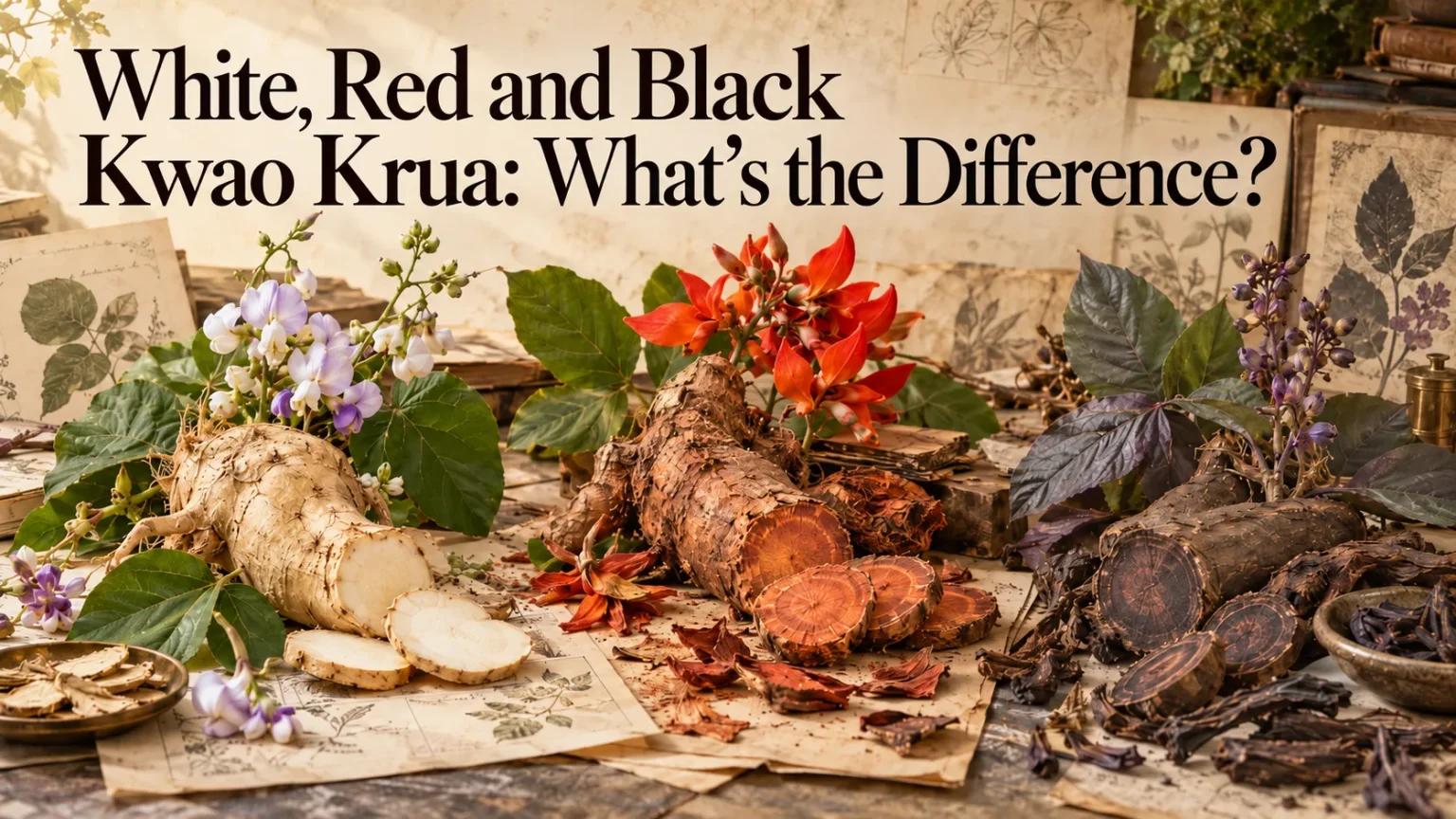
“Kwao Krua” is a Thai name shared by several unrelated plants, not one herb. White Kwao Krua (Pueraria mirifica) is the phytoestrogen-rich root most associated with women’s health. Red Kwao Krua (Butea superba) and black Kwao Krua are different plants from different genera, traditionally used by Thai men. The color tells you which plant you’re looking at, not which one is stronger.
Kwao Krua (กวาวเครือ) is a folk name in Thailand for several tuberous-root vines in the legume family that resemble each other above ground. A 2022 review in the Thai Journal of Pharmaceutical Sciences notes that white Kwao Krua is often confused with red and black Kwao Krua because, although the plants are not completely alike in appearance, their names sound similar. The color names, white, red, and black, come from the color of the tuber or stem, not from potency or a shared classification.
That distinction matters because the three plants belong to different genera entirely and have different traditional uses, as the table below shows. Treating them as interchangeable, or assuming one color is simply a stronger version of another, misunderstands what they actually are.
| Thai name | Scientific name | Key compounds | Traditional use | Who it’s traditionally for |
|---|---|---|---|---|
| White Kwao Krua (Kwao Krua Khao) | Pueraria candollei Grah. ex Benth. var. mirifica (syn. Pueraria mirifica) | Miroestrol, deoxymiroestrol, puerarin, daidzein, genistein | Thai folk medicine for rejuvenation and estrogen-like effects | Historically, Thai women |
| Red Kwao Krua (Kwao Krua Daeng) | Butea superba Roxb. | Flavonoids and other compounds distinct from Pueraria’s isoflavones | Traditionally consumed by Thai men for vitality and sexual performance | Historically, Thai men |
| Black Kwao Krua (Kwao Krua Dam) | Identified in academic sources as Mucuna macrocarpa Wall. (syn. Mucuna collettii Lace), though one 2022 review notes the species is not yet clearly settled in Thailand | Distinct compound profile from both white and red; less studied overall | Traditionally consumed by Thai men alongside red Kwao Krua, for vitality | Historically, Thai men |
| Kudzu (for comparison, not a “Kwao Krua”) | Pueraria lobata (Willd.) Ohwi | Daidzein, genistein and related isoflavones, but not miroestrol or deoxymiroestrol | Food starch, traditional Chinese medicine, hangover remedies | General use, not specifically linked to Thai women’s or men’s traditional use |
White Kwao Krua, or “Kwao Krua Khao” (kao meaning white in Thai), is the scientific name Pueraria candollei var. mirifica, with Pueraria mirifica as a commonly used synonym. The species was definitively identified in 1952. It is best known for containing miroestrol and deoxymiroestrol, potent plant estrogens that are largely unique to this plant, alongside isoflavones such as puerarin, daidzein, and genistein that it shares with other Pueraria species, per the 2022 Thai Journal of Pharmaceutical Sciences review.
In Thai traditional medicine, white Kwao Krua has historically been associated with women’s health and rejuvenation. It is also the one of the three with the most published human research behind it, mostly on menopausal symptoms and vaginal health.
Thailand also treats it as a protected resource: white Kwao Krua (listed by its formal name, Pueraria candollei Grah. var. mirifica) is one of 11 reserved plant species that cannot legally be exported from Thailand without written permission, under the Plant Varieties Protection Act, as published by Thailand’s airport authorities. Exporting it without authorization carries a penalty of up to three years’ imprisonment, a fine, or both.
For a fuller look at the plant itself, including how it compares with its close relatives, see our dedicated Pueraria Mirifica plant guide.
Red Kwao Krua, or “Kwao Krua Daeng,” is Butea superba Roxb., a vine that also grows in India, China, and Vietnam as well as Thailand. It is a completely different genus from Pueraria. Traditionally, red Kwao Krua has been consumed by Thai men, historically for vitality and to support male sexual performance, rather than for the estrogen-related uses associated with white Kwao Krua.
Animal research has specifically examined its hormonal and toxicity profile: a study of androgen disruption and toxicity in male rats tested Butea superba‘s effects in this species; the detailed dose-response results sit in the original paper and should be reviewed directly by the team before any specific figure from it is used in marketing copy.
For more on this plant specifically, see Butea Superba: Red Kwao Krua, the Thai Men’s Vitality Herb.
Black Kwao Krua, or “Kwao Krua Dam,” is named for the dark purple-to-black color of its stem and tuber. Academic papers, including work indexed on PubMed, identify it as Mucuna macrocarpa Wall. (also referenced in the literature as Mucuna collettii Lace), a different genus again from both white and red Kwao Krua. The 2022 Thai Journal of Pharmaceutical Sciences review is careful to note that this species identification is not yet fully settled in Thailand, so it is presented here as the best current academic consensus rather than a final answer.
Like red Kwao Krua, black Kwao Krua has traditionally been consumed by Thai men for rejuvenation and to maintain vitality, according to a 2004 laboratory study comparing all three Kwao Krua types. That lab (in vitro) study tested white, red, and black Kwao Krua extracts on MCF-7 breast cancer cells and found a differential anti-proliferation effect between them, meaning the three plants behaved differently from each other even in a lab dish. Black Kwao Krua is the least studied of the three overall.
Kudzu, Pueraria lobata, is a close botanical relative of Pueraria mirifica, in the same genus, but it is not a “Kwao Krua” in Thai usage and is not the same plant. Kudzu is far more widespread, native across East Asia and naturalized as a fast-growing vine in parts of the United States, and has a long history of use as a food starch and in traditional Chinese medicine.
A direct chemical comparison, referenced in the 2004 Kwao Krua lab study’s citation list, measured the major isoflavonoid content of Pueraria mirifica against Pueraria lobata and found differences in their isoflavonoid profiles. Critically, kudzu does not contain the miroestrol and deoxymiroestrol that give Pueraria mirifica its distinct estrogenic reputation. A product labeled simply “Pueraria” or “kudzu extract” is therefore not necessarily equivalent to Pueraria mirifica.
See Pueraria Mirifica and Other Pueraria Species for a fuller comparison.
Because the three Kwao Krua plants resemble each other and share overlapping folk names, mislabeling and look-alike roots are a known problem in the Thai market. This is exactly why researchers have developed DNA-based tests (PCR-RFLP) and combined molecular, chemical, and microscopic analysis methods specifically to tell white, red, and black Kwao Krua apart, and to check whether commercial white Kwao Krua products sold in Thailand actually contain what they claim.
As a buyer, look for the full scientific name on the label (not just “Kwao Krua”), and a source that can show you where the root actually comes from. Our own farm is one way we keep that traceable: showing the actual root stock, rather than a generic stock photo.
It’s also worth remembering that white Kwao Krua is a government-reserved species in Thailand, so a legitimate export supply chain involves an actual permit, not just a label claim. If a seller cannot say which of the three plants is actually in their product, or cannot point to where the root was grown, that is worth treating as a reason to ask more questions rather than assume the best.
None of this testing or sourcing information changes what any of the three plants has been shown to do. It only affects whether the product you buy is the plant it claims to be in the first place, which is a separate question from whether the research behind that plant applies to you.
Kwao Krua (กวาวเครือ) is a Thai folk name used for several different tuberous-root vine plants that look somewhat similar, not one single herb. White, red, and black Kwao Krua belong to different genera and have different traditional uses.
No. White Kwao Krua is Pueraria candollei var. mirifica. Red Kwao Krua is Butea superba, a different genus entirely. They share part of a folk name and a similar tuberous-root appearance, not a botanical classification.
Academic sources identify it as Mucuna macrocarpa (also referenced as Mucuna collettii), named for its dark purple-to-black stem and tuber, though a 2022 academic review notes that its exact species identity is not yet fully settled in Thailand.
No. Kudzu is Pueraria lobata, a related but different species, widely grown across East Asia and naturalized in parts of the United States. A direct comparison of the two found differences in their isoflavonoid content, and kudzu does not contain the miroestrol and deoxymiroestrol found in Pueraria mirifica.
Look for the full scientific name on the label, not just “Kwao Krua,” and a traceable source. Researchers have developed DNA and chemical testing methods specifically because look-alike roots and mislabeled products exist in the Thai market, so sourcing transparency matters.
Explore Stherb’s Thai herbal skincare and supplements, crafted from research-backed botanicals.
There is no single Pueraria Mirifica dosage. Here is how to read the label, compare forms, and dose safely.
Pueraria Mirifica can cause side effects because it contains biologically active phytoestrogens that interact with estrogen receptors. Reported effects include breast tenderness,…
Quick answer Enkleia thorelii has traditionally been used in Thailand for vitality, endurance, and resistance to fatigue. Its possible connection to cellular…