Quick answer
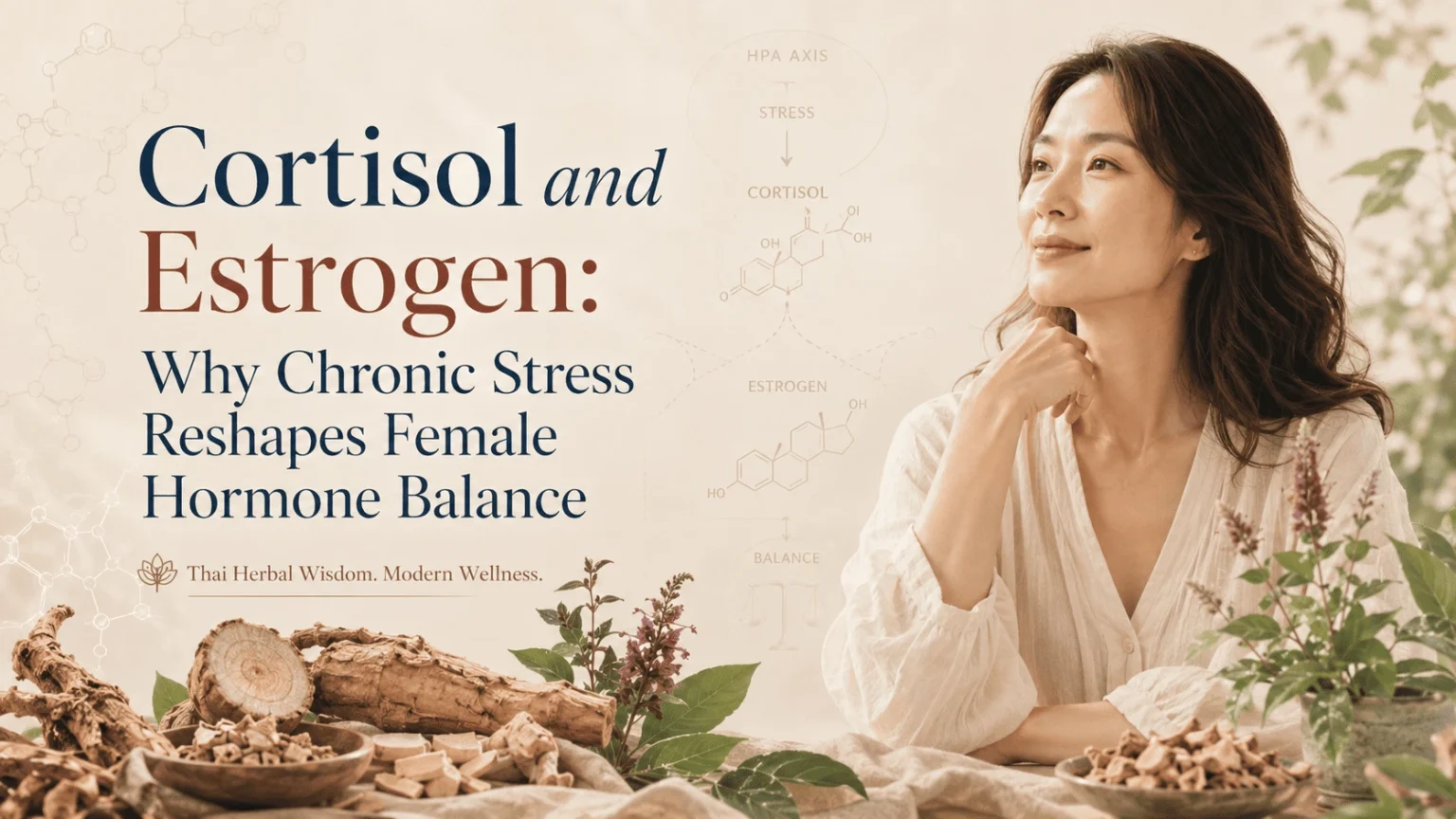
Chronic stress may reshape female hormone balance by keeping cortisol elevated,
which can affect steroid hormone production, estrogen receptor sensitivity,
and the balance between estrogen and progesterone. Supporting healthy cortisol
regulation through sleep, moderate movement, stress management, and other
lifestyle strategies may therefore play an important role in supporting
estrogen balance.
Key takeaways
-
Cortisol and sex hormones such as estrogen and progesterone share the same
upstream steroid hormone resources.
-
Chronic stress may prioritise cortisol production and contribute to changes
in the balance between progesterone and estrogen.
-
Elevated cortisol may also influence estrogen receptor sensitivity and
estrogen signalling in target tissues.
-
Cortisol-related receptor changes may affect how women respond to
phytoestrogenic herbs such as Pueraria mirifica.
-
Sleep, moderate physical activity, adaptogenic herbs, social connection,
and time in nature are discussed as ways to support healthier cortisol
regulation.
Most conversations about female hormone balance focus on the ovaries and the cycle
they govern. That makes sense. But there is another hormonal player that quietly
shapes estrogen levels, receptor sensitivity, and the entire architecture of
female hormonal health, and it is not a reproductive hormone at all. It is
cortisol, the body’s primary stress response molecule.
Chronic stress and its sustained cortisol output do not simply make you feel tired and
wound-up. Over time, they actively alter how estrogen is produced, transported,
and received by the body’s cells. For women who are doing everything right with
their herbal and nutritional support but still experiencing hormonal symptoms,
chronic cortisol elevation is one of the most commonly overlooked contributing
factors. Understanding this connection changes how you approach female hormone
support entirely.
How Cortisol and Estrogen Share the Same Upstream Resources
Cortisol, like the sex hormones estrogen, progesterone, and testosterone, is a steroid
hormone. All steroid hormones are built from the same starting material:
cholesterol. The body converts cholesterol into pregnenolone, sometimes called
the mother hormone, and then into a branching cascade of other steroid hormones
including both cortisol and the sex hormones.
When the body is under chronic stress, it prioritises cortisol production. This is a survival
mechanism. Your body treats stress as a threat requiring immediate hormonal
response, and that response takes precedence over reproductive and metabolic
hormonal needs. The problem is that all of these hormones are competing for the
same upstream raw material and enzymatic machinery.
This dynamic is sometimes called the cortisol steal or pregnenolone steal. When cortisol
demand is chronically elevated, the enzymes that would normally convert
pregnenolone into progesterone and DHEA get redirected toward cortisol
synthesis instead. The result can be a pattern where stress hormones remain
elevated while sex hormones, particularly progesterone, decline. Because
progesterone and estrogen function in balance with each other, a drop in
progesterone effectively creates a state of relative estrogen excess, even when
estrogen itself is not particularly high in absolute terms.
This is one mechanism through which chronic stress can contribute to symptoms that look
like estrogen dominance: heavy or irregular periods, mood instability, breast
tenderness, and difficulty with weight management around the hips and abdomen.
How Cortisol Disrupts Estrogen Receptor Function
Beyond the upstream hormone competition, cortisol also affects how cells respond to
estrogen at the receptor level. Glucocorticoid receptors, which cortisol binds
to, and estrogen receptors are both nuclear receptors that work by influencing
gene expression. Research has found that glucocorticoid signalling can directly
modulate the activity of estrogen receptors, sometimes suppressing their
function and sometimes altering the pattern of genes they activate.
The practical consequence is that even when estrogen levels are adequate, chronically
elevated cortisol can reduce the sensitivity of target tissues to estrogenic
signals. This is a receptor-level disruption rather than a production-level
one, and it will not show up on a standard hormone panel. You can have normal
estrogen levels on a blood test and still have reduced estrogenic signalling in
affected tissues because the receptors are not responding with their usual
sensitivity.
For women using phytoestrogenic herbs like Pueraria mirifica, this matters.
Phytoestrogens depend on functional estrogen receptors to produce their
effects. If cortisol-mediated receptor suppression is occurring, the expected
benefits of phytoestrogen supplementation may be blunted. Addressing the
cortisol environment is therefore not a separate issue from optimising herbal
supplement effectiveness. The two are connected.
Practical Ways to Lower Cortisol and Support Estrogen Balance
The most effective strategies for reducing chronic cortisol are not dramatic. They are
consistent and unglamorous, which is probably why they get less attention than
supplements and exotic interventions.
Sleep quality and duration are the most powerful cortisol-lowering tools available. Cortisol
follows a diurnal pattern, rising in the early morning to support waking and
declining through the day. Poor sleep disrupts this rhythm and tends to elevate
evening and nighttime cortisol, which interferes with the hormonal repair
processes that happen during sleep. Prioritising seven to nine hours in a dark,
cool room is not passive wellness advice. It is active hormonal management.
Physical movement at moderate intensity reduces cortisol over time, though very
high-intensity exercise without adequate recovery can have the opposite effect
in already-stressed individuals. Walking, yoga, swimming, and cycling at a
comfortable pace all tend to lower cortisol when done consistently. The key
word is consistently, because the cortisol-lowering effect accumulates with
habitual practice rather than appearing from a single session.
Adaptogenic herbs deserve a mention here. Ashwagandha, Rhodiola rosea, and holy basil have
each been studied for their ability to modulate the stress response and support
more balanced cortisol output. These are not the same as sedatives or
anxiolytics. They work at the level of the hypothalamic-pituitary-adrenal axis
to encourage more appropriate cortisol regulation without blunting the response
entirely.
Social connection, creative engagement, and time in natural settings all have
documented cortisol-lowering effects that are easy to dismiss as soft science
but are genuinely supported by research. The body’s stress response evolved in
a social, natural context. Returning to that context, even in small daily
doses, has measurable physiological effects.
Bringing Cortisol and Estrogen Into Balance Together
Cortisol and estrogen are not separate hormonal issues for women. They are deeply
interconnected, and the state of one shapes the behaviour of the other in ways
that blood tests often do not fully capture. Treating female hormonal health as
purely an ovarian issue misses a significant piece of the picture.
If you are supporting your hormonal health with herbs, nutrition, and lifestyle but still experiencing symptoms, assessing your actual stress load and cortisol patterns is a reasonable next step. Sometimes the most impactful thing a woman can do for her estrogen balance is to genuinely address her chronic stress, not as a wellness platitude but as a real physiological intervention.