Wellness
Does Pueraria Mirifica Cause Weight Gain?
Weight on the scale is not the same as body fat. See what research says about Pueraria Mirifica, water retention and where…

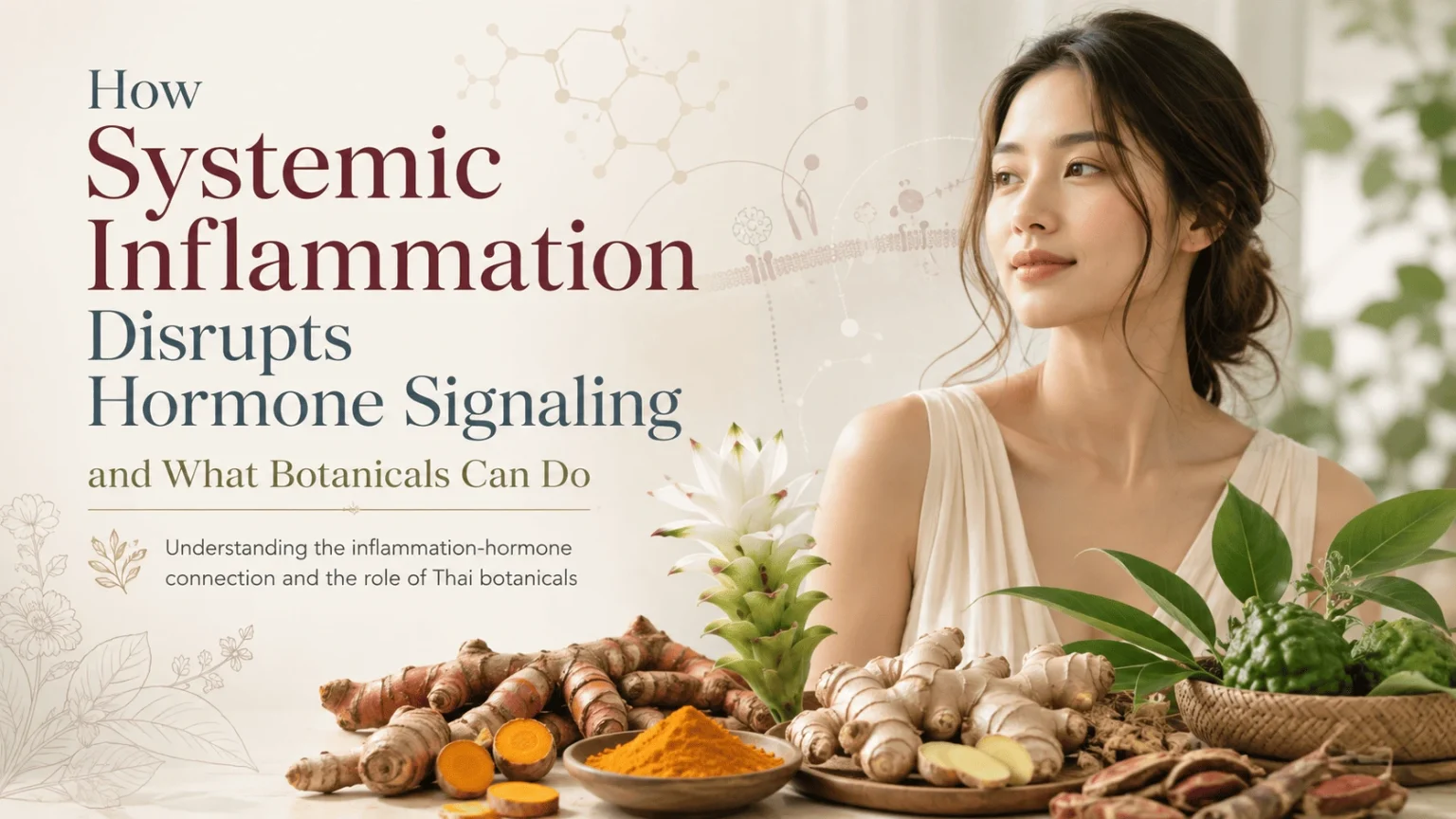
Systemic inflammation can interfere with hormone production, transport, and receptor sensitivity, which may affect how effectively hormonal signals are received throughout the body. Botanical compounds such as curcumin, Kaempferia parviflora, and ginger may provide anti-inflammatory support and help improve the broader environment in which hormonal signaling occurs.
Most people think of inflammation and hormone imbalance as separate problems. You take something for inflammation and something else for hormones. But the two systems are far more entangled than this separation suggests, and treating them in isolation often means addressing symptoms without touching the underlying cause.
Systemic inflammation, the low-grade, persistent kind that does not announce itself with obvious redness or swelling, quietly disrupts the way hormones are produced, transported, and received by cells. If you have been dealing with hormonal symptoms that do not fully resolve despite reasonable diet and lifestyle efforts, inflammation could be the missing piece. Understanding how this disruption works, and what botanical compounds can do to address it, is genuinely useful.
The body’s hormonal system is a finely tuned communication network. Glands produce hormones, those hormones travel through the bloodstream, and cells receive the signal through specific receptor proteins. Inflammation throws a wrench into this process at multiple points simultaneously.
At the production level, inflammatory cytokines, particularly interleukin-6, tumour necrosis factor-alpha, and interleukin-1 beta, can suppress activity in the hypothalamic-pituitary axis. This is the master command centre for hormonal regulation. When the hypothalamus and pituitary are operating under inflammatory stress, their signalling to downstream glands like the ovaries, testes, thyroid, and adrenal glands becomes less precise. Production of sex hormones, thyroid hormones, and cortisol regulation can all be affected.
The adrenal glands deserve particular attention here. Chronic inflammation pushes the adrenals toward cortisol production, because cortisol is the body’s primary anti-inflammatory hormone. This is a logical short-term response. But when the inflammatory signal is ongoing, the adrenals stay in a chronically stimulated state, and other hormonal priorities get deprioritised. This is one mechanism behind what is sometimes called adrenal fatigue, though the clinical picture is more nuanced than that term implies.
Sex hormone binding globulin, the protein that transports sex hormones through the blood, is also influenced by inflammatory signalling. Elevated inflammation tends to alter SHBG levels in ways that affect how much free, bioactive hormone is available to cells. You can have technically normal total testosterone or estrogen on a blood test while simultaneously having reduced bioavailable hormone because the transport protein balance is off.
Even when hormone production is adequate, inflammation can reduce how well cells respond to hormonal signals. This happens through a process called receptor downregulation. Sustained inflammatory cytokine exposure can reduce the number of functional hormone receptors on cell surfaces or impair the intracellular signalling cascade that follows receptor binding.
This mechanism has been studied most extensively in the context of insulin resistance, where chronic inflammation impairs insulin receptor function and leads to elevated blood sugar despite normal or elevated insulin levels. The same basic principle applies to sex hormone receptors, particularly in reproductive tissue. Cells exposed to chronic inflammatory signals may require stronger hormonal input to produce the same response they would generate in a less inflamed state.
Estrogen receptor alpha and estrogen receptor beta, the two main estrogen receptor subtypes, both show sensitivity to inflammatory modulation. Research in cell cultures has found that certain cytokines can alter the expression ratio between these two receptor types, which changes the character of the estrogenic response in affected tissue. For women using phytoestrogens like those in Pueraria mirifica, this means that the effectiveness of the supplement can be partly determined by how much systemic inflammation is present.
This is not a reason to avoid phytoestrogens. It is a reason to consider anti-inflammatory support alongside them, particularly if you live with any of the common sources of chronic inflammation: poor sleep, high stress, excess visceral fat, gut permeability issues, or diets heavy in refined carbohydrates and industrial seed oils.
Several well-studied botanicals work at the inflammatory signalling level in ways that are meaningful for hormonal health. They do not replace a good diet or lifestyle, but they can provide targeted support that addresses the inflammation-hormone disruption cycle directly.
Curcumin from Curcuma longa is the most extensively researched plant anti-inflammatory compound. It inhibits NF-kB, a master regulatory protein that controls the expression of many inflammatory genes. Multiple clinical trials have confirmed that curcumin supplementation lowers markers of systemic inflammation including C-reactive protein, interleukin-6, and tumour necrosis factor-alpha. Bioavailability is low in standard form, so preparations using piperine enhancement or phospholipid complexes deliver more consistent results.
Kaempferia parviflora, a Thai herb related to ginger, has shown anti-inflammatory activity through inhibition of cyclooxygenase enzymes and modulation of inflammatory cytokine production. Its polymethoxyflavones appear to be the key active compounds. This anti-inflammatory activity may complement its better-known effects on energy metabolism and circulation.
Ginger root, Zingiber officinale, contains gingerols and shogaols that inhibit arachidonic acid metabolism, the same pathway targeted by non-steroidal anti-inflammatory drugs. Unlike pharmaceutical options, ginger also provides antioxidant support and has a long traditional record of safe use. Including fresh or high-quality dried ginger consistently is one of the simpler botanical strategies with reasonable evidence behind it.
Combining these anti-inflammatory botanicals with phytoestrogen-rich herbs is an approach rooted in traditional Thai compound formulas. The traditional practitioners who developed these formulas may not have spoken the language of cytokines and receptor downregulation, but their intuition about addressing the broader body environment alongside specific hormonal herbs was sound.
Inflammation hormone signaling disruption is not a fringe concept. It is an established area of endocrine research with practical implications for anyone using herbal hormonal support. If your results from phytoestrogen supplementation have been inconsistent or underwhelming, looking at your inflammatory load is a reasonable next step.
Reducing dietary sources of inflammation, supporting gut integrity, managing sleep and stress, and adding well-studied botanical anti-inflammatories can meaningfully shift the environment in which your hormonal herbs operate. The body works as a connected system, and the most sustainable hormonal support strategies respect that connection rather than trying to work around it.
Explore Stherb’s Thai herbal skincare and supplements, crafted from research-backed botanicals.
Weight on the scale is not the same as body fat. See what research says about Pueraria Mirifica, water retention and where…
Quick answer Herbal supplement tolerance can develop when the body adapts to repeated exposure through mechanisms such as receptor downregulation, faster compound…
Quick answer Zinc and magnesium provide important nutritional support for hormone-related processes that herbal supplements depend on. Zinc is involved in testosterone…